Of everything that arrives in December mail, the handmade card is the one that stays on the mantel after the printed ones have been recycled. People keep DIY Christmas cards because the evidence of time is right there in the brushstrokes: somebody sat down and made this, for them. This guide to diy christmas cards for 2026 covers designs by skill level, from a child’s fingerprint reindeer to stitched and pop up cards, plus the batch production method that makes thirty cards feel like a pleasure instead of a sentence.
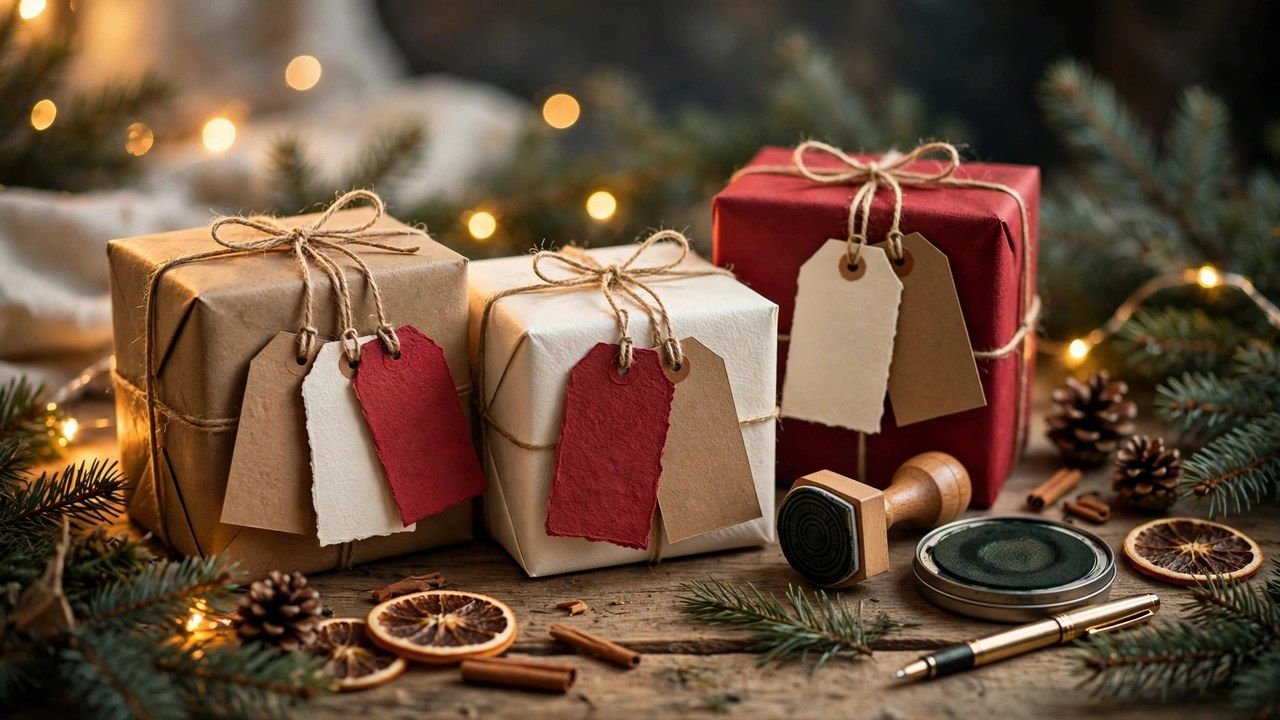
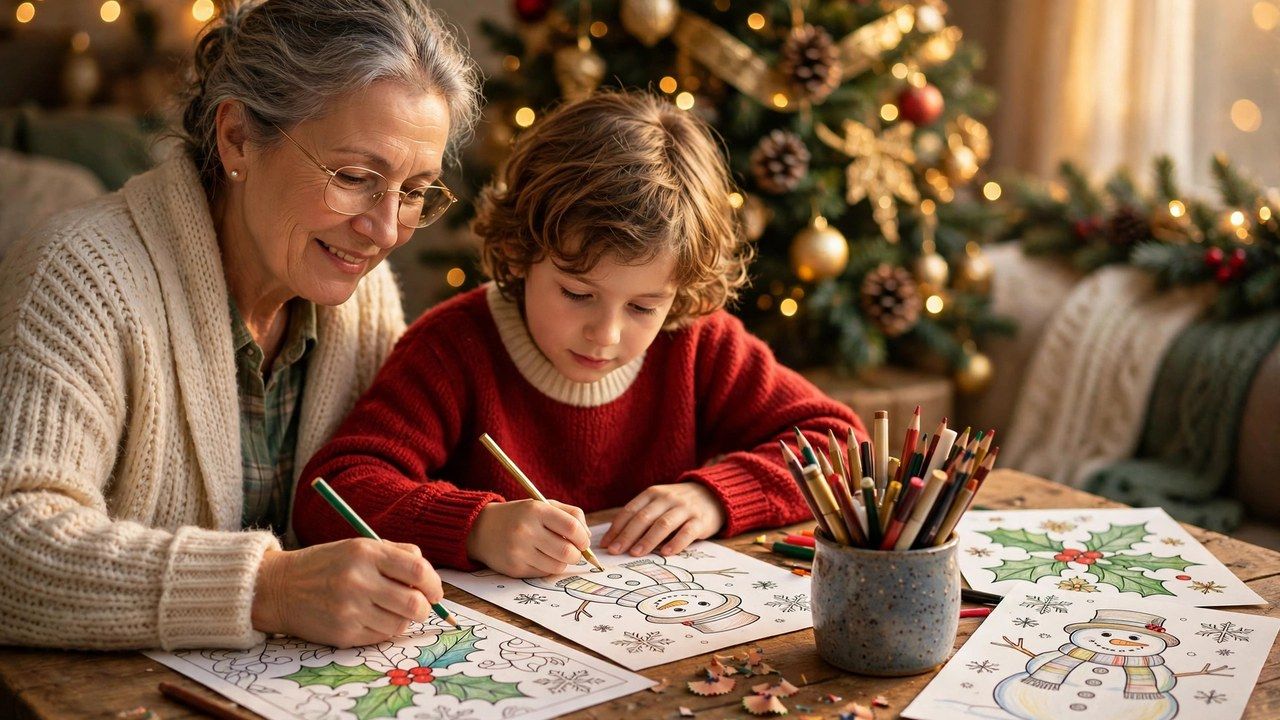
Handmade cards belong to a family of paper crafts: our gift tag ideas share the same card stock and tools, our coloring pages guide can supply artwork for card fronts, and when the making is done and the blank inside stares at you, our message ideas come via the companion traditions in our letters to Santa guide for children’s cards and family updates. Choose your designs first; the words come easier once the card exists.
Why Handmade Cards Get Kept
A handmade card signals something no beautiful bought card can: unrecoverable time, spent on one person. Recipients know the difference instantly, and they respond by keeping handmade cards at rates no printer can match, tucked into books, pinned on boards and re-read in January. The card does not need to be skilled to earn this. A wobbly hand drawn tree from a grandchild outranks a flawless foiled design from a shop every time, because the wobble is the message.
There is a maker’s dividend too. Card making is one of the few December crafts that produces gifts at the speed of an assembly line once you settle on a design, uses up the beautiful paper scraps every crafter hoards, and gives children a genuine production role in the family’s giving. The sections below are organized as a ladder: pick the rung that fits your hands and your list length, and climb only if you want to.
The Starter Kit: What You Actually Need
Blank cards and envelopes in one or two sizes are the foundation; pre folded blanks save more time than any other purchase. Add a fine black pen, a white gel pen, watercolor or gouache paints with one good brush, a glue stick and a craft glue for heavier pieces, scissors and a paper trimmer if you have one, plus your decorative layer: stamps, washi tape, ribbon offcuts, buttons, or printed photos. That modest kit covers every design in this guide except the stitched cards, which add a needle, thread and a piercing tool or a steady hand with a pin.
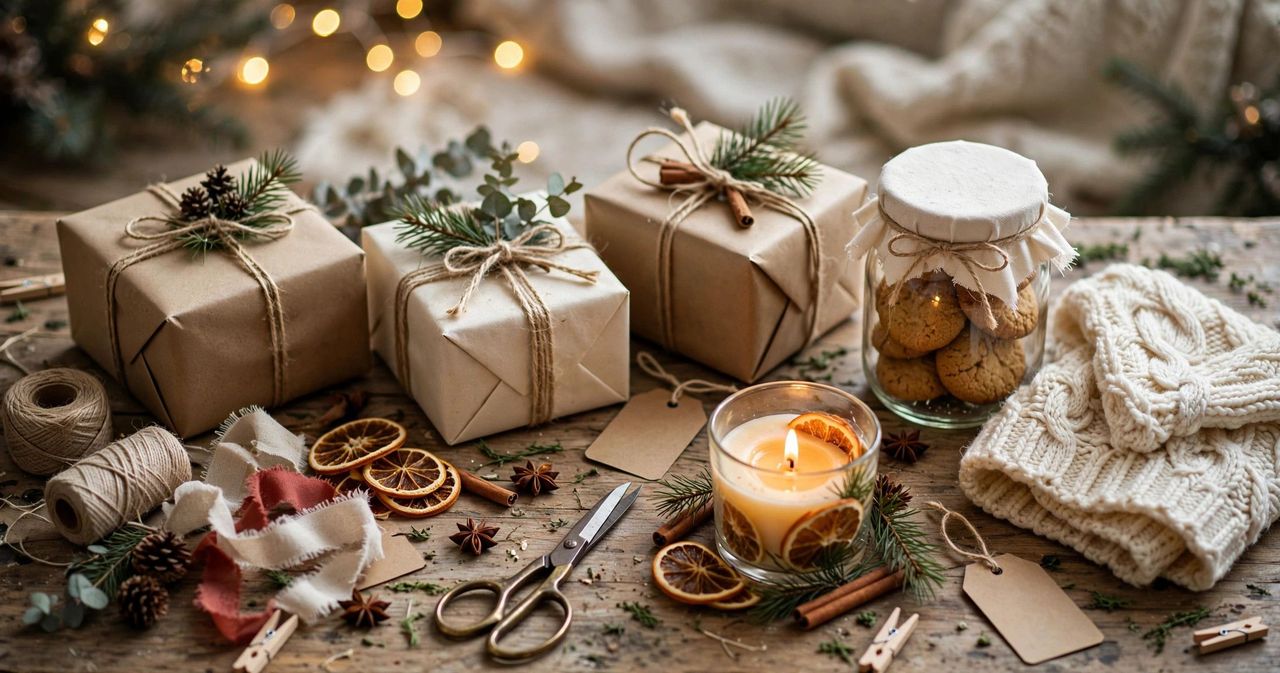
Buy the envelopes first if you are cutting your own card blanks, and make the card to fit the envelope, never the reverse; odd sized handmade cards are the ones that bend in the post. Keep a scrap box beside you as you work, because tag making, snowflake cutting and card collages all feed from the same offcuts, an ecosystem our gift tag guide relies on too.
Beginner Designs That Look Intentional
Fingerprint and handprint cards are the beloved entry point: a child’s brown fingerprint reindeer with a red nose and drawn antlers, a white handprint tree, or a row of fingerprint baubles on a drawn string. Washi tape designs build trees, candles and parcels from strips of patterned tape, needing no drawing at all. Simple stamp cards, one bold tree or star stamped in a single color with a hand lettered greeting beneath, look like Scandinavian design rather than a shortcut, especially on kraft blanks.
Collage cards layer torn or cut paper, last year’s card fronts, sheet music, maps and wrapping scraps into trees, houses and abstract winter scenes; torn edges look more artistic than cut ones and forgive unsteady hands. All four beginner families share one quality: the design is the process, so a card that took four minutes still looks deliberate, which is exactly what a batch of forty needs.
Intermediate Designs: Watercolor, Photo and Lettering
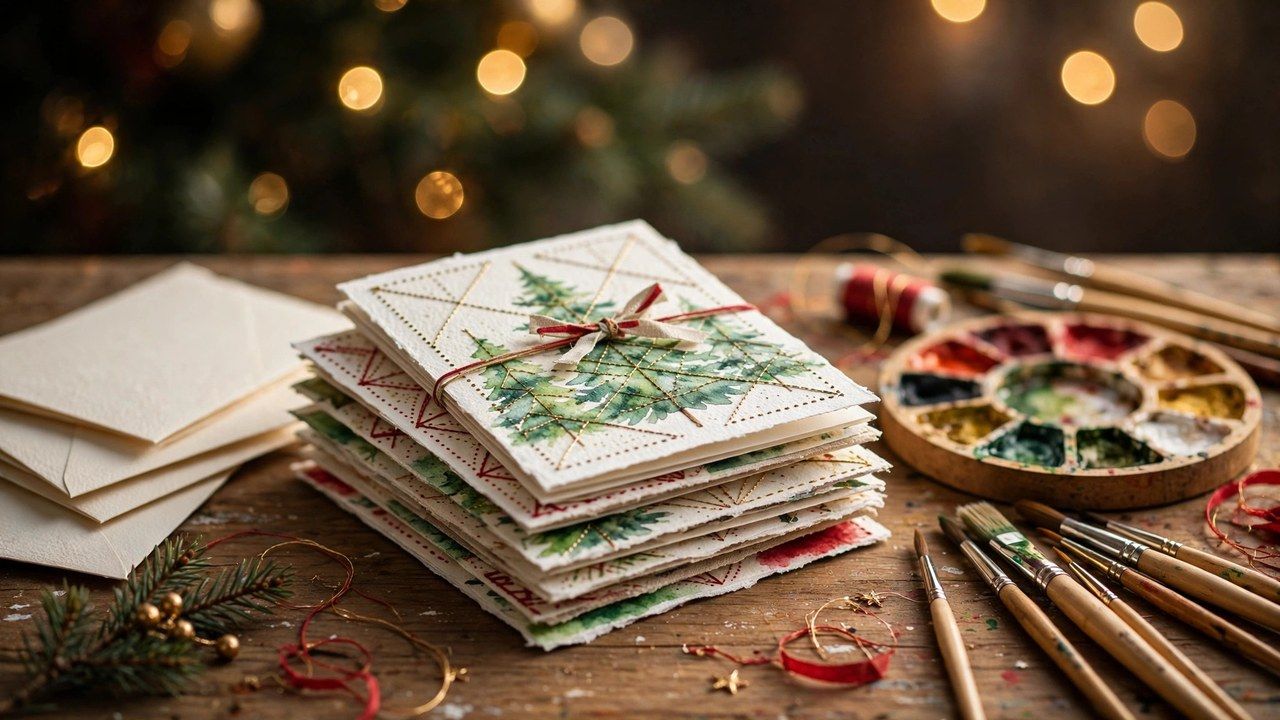
Watercolor cards reward the simplest subjects: a loose green triangle tree with a gold star, baubles as colored circles with painted strings, a wash of deep blue sky with white gouache snow and one white tree silhouette. Paint ten fronts in one sitting while the palette is wet, and accept the variation between them as the handmade signature. Photo cards mount one good photograph on a card blank with a border of card or tape; the handmade frame upgrades a print into a keepsake, especially the coordinated shots planned in our Christmas photo outfits guide.
Hand lettering turns the greeting itself into the artwork: one word, Joy, Peace, or the family name, written large in faux calligraphy with thick downstrokes, surrounded by a simple drawn wreath or a snowfall of white dots. Practice the word ten times on scrap first; the eleventh attempt is your card. Lettering pairs beautifully with the stamped and minimal styles in our tag guide, giving your whole season’s stationery one recognizable hand.
Advanced Designs: Stitched, Pop Up and Shaker Cards
Stitched cards sew the design in thread: a tree outline, a star, or a bauble with a hanging thread line. Pierce the holes evenly first with a pin over a foam pad, then sew with a blunt needle and embroidery thread, taping thread ends flat inside. The texture is unlike anything print can do, and these are the cards recipients run a finger over. Keep designs geometric and large; thread forgives bold shapes and punishes fiddly ones.
Pop up cards hide a folded tree or a row of houses that stands when the card opens, built from one extra folded insert glued along the spine. Shaker cards trap sequins and fake snow behind a clear window cut into the front. Both are engineering as much as art, both delight children beyond all proportion, and both should be prototyped once before batch production, because the first attempt always teaches you where the glue actually needed to go.
The Batch Method: Making Thirty Cards Without Losing Heart
Professionals and happy amateurs share one secret: never make one card thirty times in a row; make thirty cards one stage at a time. Choose one design, then cut and fold all blanks, decorate all fronts, let everything dry in a single layer, add lettering to all, then write and address all in a separate sitting with your list beside you. Each stage uses one set of tools, your hands learn the motion by card five, and the pile of finished fronts growing beside you is its own motivation.
Set a realistic design per list tier: your most laborious design for the ten closest people, a mid level design for the next twenty, and a handsome stamped design you can produce happily for everyone else. Nobody compares cards across households, and a warm message inside a simple card beats a masterpiece that never got made. Start in November if you can; December card making should be the victory lap, and our family activities guide offers plenty to do with the time you save.
Envelopes, Writing and Mailing Without Damage
Decorate envelopes lightly: a matching stamp, a strip of washi tape, or the name lettered with the same pen as the card ties the set together, and a decorated envelope survives the postal system better when the decoration is flat. Write the inside message when fronts are fully dry, using your best ordinary handwriting rather than a performance script; sincerity reads better than calligraphy attempted under time pressure, and the wording help in our wishes for family collection fits handmade cards naturally.
Mailing protection matters for dimensional cards: stitched, pop up and shaker cards travel best in a padded envelope or with a protective card layer over the front, and anything with glued on pieces deserves a hand stamped request at the counter where available. Post early enough that a handmade card is not racing the holiday; the whole point of the object is unhurried feeling, and a card that arrives on December 27th wearing your effort still lands better than no card, but one that arrives on the 18th lands best of all.
Honest Pros and Cons of Making Your Own Cards
Pros: unmatched keepsake value, low cost per card once the kit exists, a genuine role for children in family giving, and total creative control. Cons: time, honestly counted, is higher than buying, ambitious designs multiply their difficulty across a long list, and dimensional cards cost more to post safely. The balanced verdict most makers reach: handmade for the people who will keep them, a beautiful bought card for the long tail of the list, and no guilt attached to the boundary.
Conclusion
A handmade Christmas card is a small, durable proof that someone mattered enough to make something for. Choose designs at your true skill level, produce them in calm batches, protect them in the post, and write like yourself inside. Start with ten cards for the people who will keep them forever, and let the tradition grow at the speed of pleasure rather than obligation.