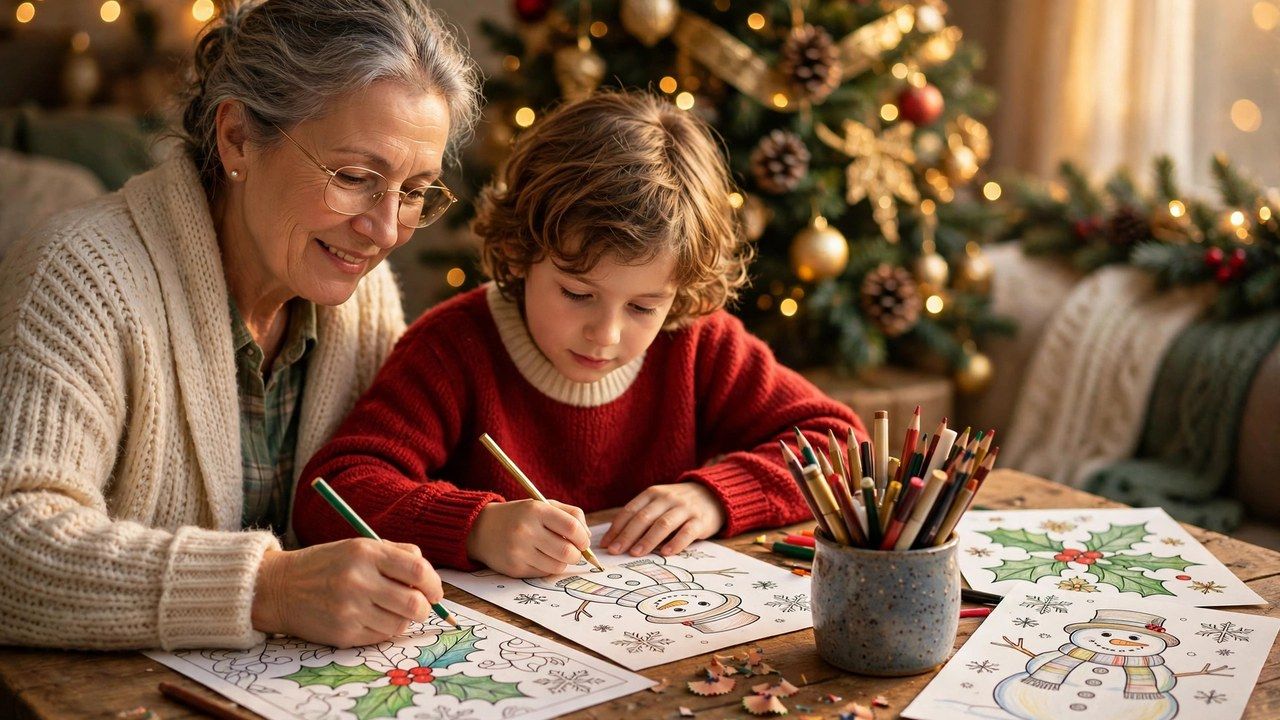
Few December activities are as quietly perfect as a table full of Christmas coloring pages, a pot of pencils and nowhere else to be. Coloring is screen free, nearly silent, cheap, and genuinely absorbing for a four year old and her grandmother at the same time. This guide to christmas coloring pages for 2026 is a design and craft guide: the themes worth choosing for each age, how to judge line art quality, the paper and printer settings that make pages satisfying to color, and what to do with finished artwork.
One honest note about what this guide is: it describes designs, themes and printing methods so you can choose and print pages well from the sources you already use. It does not promise a hosted download library, because the value here is curation and craft, knowing which designs suit which hands, and how to print them so the lines stay crisp. If you want more paper based projects after this one, our paper snowflakes tutorial and DIY Christmas cards guide make natural companions.
Why Coloring Pages Never Leave the December Rotation
Coloring survives every trend cycle because it solves several December problems at once. It calms excited children during the long wait for events, gives visiting relatives of different generations a shared activity that needs no rules explained, and produces artwork that becomes decoration, cards and gift wrap accents. Adults have claimed it too: detailed festive scenes offer the same low stakes focus as a puzzle, with a finished picture at the end instead of a thousand pieces returning to a box.
It is also one of the few seasonal crafts with no drying time, no glue and no glitter migrating through the house until July. Set out pages and pencils on a side table and the activity runs itself in the background of the whole season, which is why it features in so many of the plans in our Christmas family activities guide. The craft rewards a little curation, though, and that starts with choosing designs by age and appetite.
Design Themes for Toddlers and Young Children
For ages two to five, the design rules are simple: one big friendly subject per page, very thick outlines, large open areas, and nothing scary or fiddly. A smiling snowman, a reindeer face, a single Christmas tree with oversized baubles, a stocking, a gingerbread figure and a big cheerful Santa all work. Pages crowded with tiny presents, patterned backgrounds or thin detail frustrate small hands and end in scribble and abandonment, which is a design failure, not a child failure.
Short sessions are normal at this age, so judge success by return visits, not finished pages. Thick crayons and washable markers suit the grip and the furniture, and printing each favorite design twice, once for practice chaos and once for the fridge door masterpiece, removes all pressure. Many families pair a coloring table with story time, choosing pages that match the tales in our Christmas books for kids guide so characters jump from page to page.
Design Themes for Older Kids: Scenes, Characters and Challenges
From about six to twelve, children want scenes and stories: Santa’s workshop with elves and toy shelves, a village under snow, reindeer mid flight over rooftops, a cozy fireplace with stockings and a sleeping cat, or a nativity scene for families who want one. Medium weight lines and a mix of large and small areas let them practice staying inside lines on the easy shapes and showing off on the details. Word art pages, where lettering forms part of the picture, also land well with this group.
Challenge formats extend the appeal for the older end: symmetry pages to complete, color by number scenes, and pages hiding small objects to find and color. If a child finishes every page in flat single colors, offer a gentle upgrade rather than a correction: shading one area, adding falling snow with a white crayon over color, or outlining finished shapes in a darker shade. The moment coloring becomes a skill they are visibly improving at, it holds them for hours.
Designs for Teens and Adults: Intricate, Calm and Frameable
Adult coloring design is a different art form: mandalas built from baubles and holly, intricate winter villages, detailed wreaths, patterned ornaments, woodland animals in fine line work, and vintage style scenes. The pleasure is in density, hundreds of small decisions that quiet a busy mind. Look for clean, confident line work with varied shape sizes, because pages made of one repeated tiny pattern become tedious rather than meditative.
Fine tipped pens, gel pens and good colored pencils are the tools this level deserves, and the finished results genuinely earn frames, especially the symmetrical and wreath designs. A set of adult pages also makes a thoughtful, inexpensive gift alongside pencils, an idea that sits comfortably in the handmade spirit of our DIY Christmas gifts guide. Choose a few excellent designs rather than a mountain of mediocre ones; adults abandon weak line art instantly.
How to Judge Line Art Quality Before You Print
Good coloring line art has closed shapes, so color stays where it belongs, lines of consistent weight, and no grey fuzziness, which signals a low resolution image that will print soft and disappoint. Zoom in before printing: outlines should look like clean black ribbons, not dotted or blurred edges. Avoid pages where important details are drawn in pale grey, since they vanish under the first layer of pencil.
Composition matters too. The best designs fill the page with a clear focal subject, breathing room around it, and detail distributed evenly rather than one hyper detailed corner and a blank rest. For children, check that similar shapes are not easily confused, and for everyone, check the design actually matches its description before you print twenty copies for a class or party table.
Paper, Printer Settings and Ink Smart Choices
| Tool | Best paper | Watch out for | Best designs |
|---|---|---|---|
| Crayons | Standard copy paper | Wax can smudge fine detail | Bold toddler and kids designs |
| Colored pencils | Smooth heavier paper or card stock | Very rough paper eats pencil points | Detailed scenes, shading work, adult pages |
| Felt markers | Marker paper or card stock | Bleed through on thin paper; place a spare sheet beneath | Bold outlines, word art, bright kids scenes |
| Gel pens | Smooth card stock | Wet ink smears under a resting hand | Intricate adult designs, metallic accents |
Printer settings make or break the result. Print at the highest quality your patience allows, choose the correct paper type in the print dialog, and use fit to page scaling so no edge art is cropped. For pencil work, standard black printing is right; if your printer offers a draft or toner saving mode, skip it for coloring pages, because pale grey lines are miserable to color over. Printing a small stack of each chosen design beats printing one of everything, since children invariably want the same snowman as their cousin.
What to Do With Finished Pages
Finished artwork deserves a fate better than a pile. String favorite pages into a simple garland with clips along a mantel or hallway. Trim scenes into card fronts, which connects neatly with the methods in our DIY Christmas cards guide. Wrap a small gift in a colored page as one of a kind paper, back a page with card and frame it for a child’s room, or photograph pages and send them to grandparents who live far away, which turns a quiet afternoon into a gift that actually travels.
Keepsake discipline helps too: date the back of each page, keep one or two best pieces per child per year in a folder, and recycle the rest without ceremony. A slim annual folder becomes genuinely treasured, while a box of two hundred undated pages becomes clutter. Children copy the value you place on their work, so displaying a chosen piece properly teaches more than saving everything loosely.
Honest Pros and Cons of Coloring as a Holiday Activity
Pros: extremely low cost, no mess beyond pencil shavings, works for almost every age and ability, calms busy gatherings, and produces usable artwork. Cons: printer ink is the hidden expense if you print carelessly, poor quality designs frustrate every age group, and markers plus toddlers plus pale furniture is a combination that still needs supervision. Print thoughtfully, choose designs deliberately, and the balance lands firmly in favor of keeping a coloring corner all season.
Conclusion
Great Christmas coloring is mostly curation: bold simple pages for small hands, story filled scenes for older kids, and intricate line art worthy of adult patience, all printed crisply on paper matched to the tools. Set up a corner, rotate fresh designs in through December, display the best work proudly, and this cheapest of crafts will quietly become one of the season’s most returned to pleasures.