On Christmas Eve, one question takes over every household with young children: where is Santa right now? The santa tracker tradition turns that question into an evening long event, as families follow Father Christmas across a world map, time zone by time zone, until the map gets uncomfortably close to home and somebody small is sent to bed at speed. This guide explains how the two famous trackers work, the wonderful accident that started it all, and how to build a Christmas Eve ritual around them.
This is a descriptive guide to two well known programs, NORAD Tracks Santa and Google Santa Tracker. Exact launch details can vary by year, so for the current season’s specifics, check each program’s own announcements as Christmas Eve approaches rather than relying on any article, including this one. For the rest of the Eve ritual, our Christmas Eve traditions guide and Elf on the Shelf ideas complete the evening.
The 1955 Story: How a Misprinted Number Started It All
The Santa tracking tradition began, remarkably, with a printing error. In 1955, a department store advertisement invited children to call Santa on a special phone number, but the number was misprinted, and the calls instead reached a military command center in Colorado, the predecessor of what is now NORAD, the North American Aerospace Defense Command. The officer on duty that night, Colonel Harry Shoup, understood the assignment instantly: he had his team check the radar for signs of a sleigh and give the children updates instead of disappointment.
That improvisation became an institution. The command continued the service in following years, and what is now NORAD Tracks Santa grew into a beloved annual program with volunteers answering calls and emails from children around the world, alongside the famous online map. It is one of the great accidental traditions: a wrong number, a kind officer, and seventy years of Christmas Eves organized around a blip on a map.
How NORAD Tracks Santa Works
NORAD brings its real day job to the story, which is exactly why children find it so convincing. In the program’s telling, the tracking uses the same kinds of systems NORAD uses to watch the skies over North America: radar to spot the takeoff from the North Pole, satellites that can detect the infrared glow of a famous red nose, and fighter jets that welcome Santa as he enters Canadian and American airspace, all reported with a completely straight face.
For families, the experience centers on the live map on Christmas Eve, which shows Santa’s current location and next stop, alongside videos, games and information available through the season in the program’s Santa village style pages. Children can also traditionally reach the operations center by phone or email on the day itself to ask a volunteer where Santa is, a detail that still amazes adults who grew up with the hotline. Because schedules and features are set fresh each year, confirm the current year’s details on the program’s official channels in December.
How Google Santa Tracker Works
Google’s Santa Tracker grew from a different root: a playful technology showcase that became a family tradition of its own. Through December, its Santa Village traditionally offers a calendar of games, coding activities and short animations that unlock as the month goes on, turning the tracker into an advent style experience rather than a single night event. On Christmas Eve, the village gives way to the live tracker, following Santa and his reindeer across a world map with location updates and gift delivery counts presented for fun.
The two trackers have different flavors. NORAD leans into the military precision comedy of radar, jets and official updates, which older children find thrillingly credible. Google leans into games, characters and bright interactive play, which suits younger children through the whole month. Many families use both: Google’s village for December’s countdown, NORAD’s map for the serious business of Christmas Eve itself. Neither requires anything more than a browser or an app store visit, and both are free for families to enjoy.
Building the Christmas Eve Ritual Around the Tracker
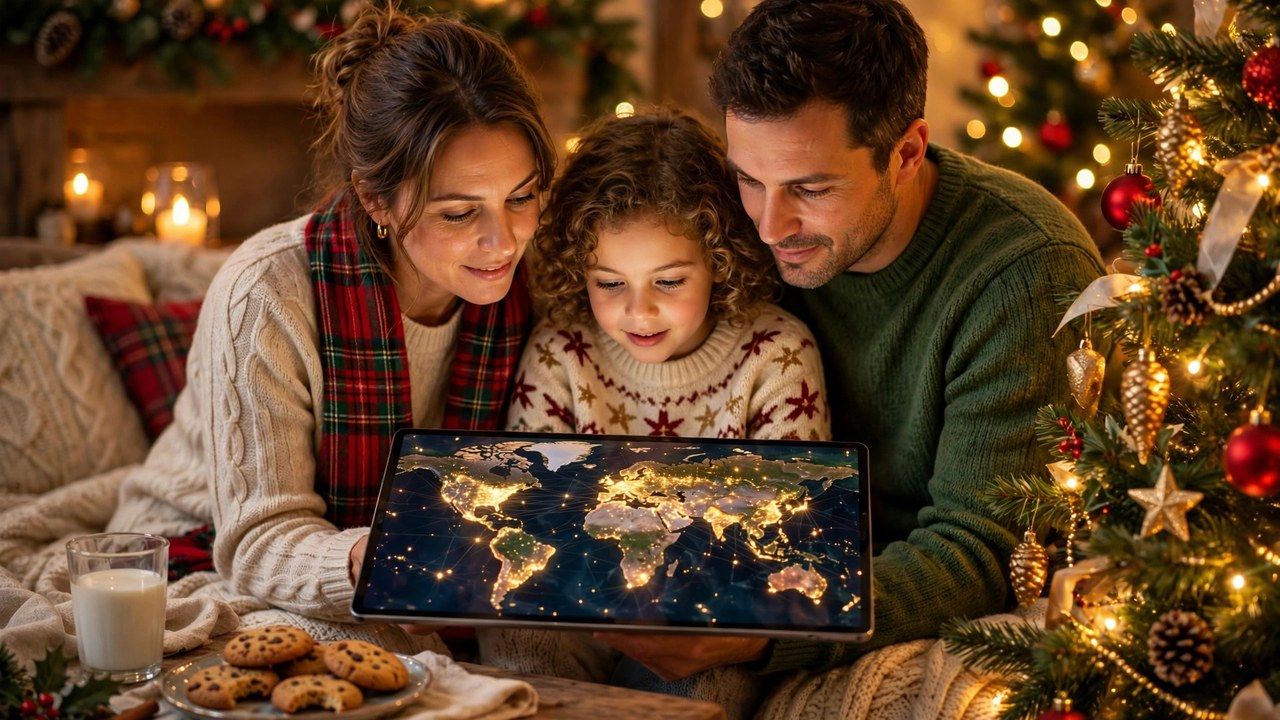
The tracker works best as the evening’s clock. Start after dinner with a first check in: find Santa on the map, note how far away he is, and let that distance set the pace of baths, pajamas and final preparations. Check again at agreed moments rather than continuously, because anticipation stretched across the evening is the entire pleasure, and a map refreshed every ninety seconds loses its drama by seven o clock.
Build the classic stations around the checks: cookies and milk prepared and placed, reindeer food sprinkled outside if your family follows that tradition from our reindeer food guide, stockings hung, and one last story. The final check should carry a house rule every parent learns quickly: when Santa reaches your time zone or the country next door, he cannot land while children are awake, which converts the tracker into the world’s most persuasive bedtime argument.
Making It Educational Without Ruining It
A world map crossed in one night is a geography lesson in disguise. Children absorb time zones viscerally when they watch it be night in one country and morning in another, and capital cities stick when they matter to the route. Parents can lean in lightly: find each new country on a globe or atlas, greet it in its own language using our Merry Christmas in different languages guide, or guess which famous landmark Santa passes next.
The educational layer should stay a garnish, not a lesson plan. One interesting fact per check in, an ocean named, a continent traced, is plenty. The night’s curriculum is wonder, and wonder has an excellent record of teaching geography all by itself once a child cares where in the world the sleigh currently is.
Tracker Tips for Parents
Test your setup before the evening: open the tracker earlier in the day, check it loads on the television, tablet or phone you plan to use, and agree which device is the family’s mission control. Charge everything. Christmas Eve has a unique talent for producing a flat battery at the exact moment of maximum excitement.
Manage the endgame carefully. Very young children may find the map’s approach genuinely suspenseful, so frame distance positively: Santa is still delivering to children far away, and our turn comes after sleep. For older children who are beginning to suspect, the tracker often becomes a fond family performance everyone collaborates in, and there is no need to force a conversation the night itself is not asking for. Our Christmas countdown ideas help pace the final week so Eve does not carry the whole season’s excitement alone.
What About Other Trackers and Apps?
Beyond the two famous programs, December brings a crowd of tracker apps, videos and websites of varying quality. The safe approach for families is to anchor on the two long running, official programs described here, and to treat unknown apps with normal caution: check what an app asks to access before installing it on a child’s device, and prefer browser based experiences that ask for nothing.
Videos that simulate tracking can still be fun for very young children, but the live map shared by the whole internet at once has a communal magic no simulation matches: your children are watching the same Santa as their cousins in another city. That shared fiction, maintained by volunteers, engineers and millions of parents at once, is the real technology on display every Christmas Eve.
After the Tracker: The Quiet Part of the Night
When the map finally delivers Santa to your region and the children are asleep, the tracker’s job is done and the parents’ shift begins. Many families keep the map open while they work, enjoying the strange peace of a house mid transformation. It is worth pausing in that hour to appreciate the tradition itself: a misprinted phone number in 1955 became a global volunteer effort that still, all these years later, answers children seriously on the one night it matters most.
Tomorrow, of course, the questions change from where is Santa to entirely different investigations about how he managed the chimney. Our Christmas Day schedule guide can help you pace what comes next. Tonight, the map says he is on his way, and that is quite enough.
Conclusion
Open the tracker after dinner, let the map pace the evening, learn a little geography by stealth, and send everyone to bed when Santa crosses into your time zone. NORAD’s radar comedy and Google’s playful village are two flavors of the same gift: one more hour of believing, shared by the whole world at once.