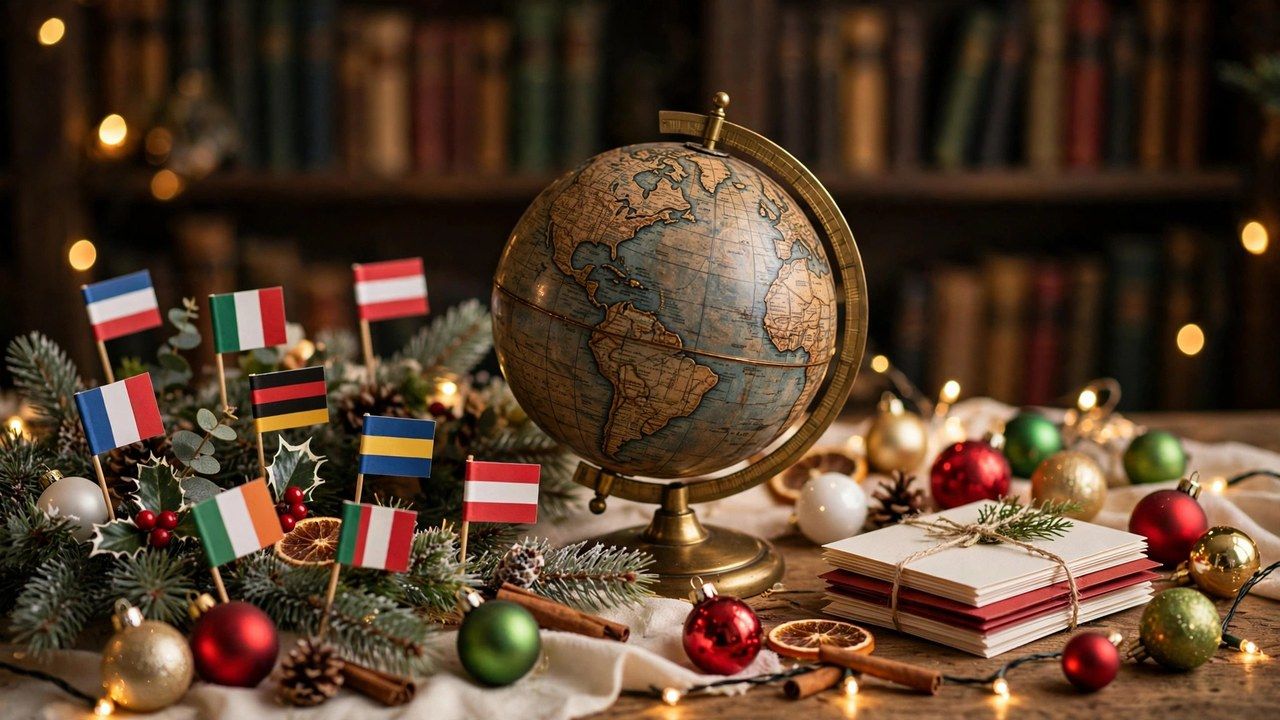
One greeting, forty ways to say it, and a whole world celebrating in the same week. Learning how to say Merry Christmas in different languages is part party trick, part genuine kindness: the right greeting in a colleague’s, neighbor’s or in law’s own language lands with a warmth that English sometimes cannot. This festive phrase guide gives you merry christmas in 40 languages, twenty two from Europe and eighteen from the rest of the world, with honest notes on pronunciation and the situations where each greeting shines.
Use this guide alongside our Christmas traditions around the world for the customs behind the words, and our wishes for family and wishes for friends when you want to build a full card message around your chosen phrase. Every greeting below is a well established, widely used form; where a language has several variants, we have chosen the most common one and said so.
How to Use This Guide (and a Word About Pronunciation)
Greetings are written the way you will most often see them, in their standard spelling, with simplified transliteration where the original script is not the Latin alphabet, as with Russian, Greek, Mandarin and Japanese. Stress and tones are simplified too: this guide gets you understood and appreciated, not accent perfect. The golden rule with any borrowed greeting is cheerful confidence; a warmly delivered approximation earns smiles everywhere, while a mumbled perfect rendering earns a request to repeat it.
A few languages greet the whole season rather than the day itself. Polish Wesołych Świąt literally wishes happy holidays, and it is the natural Christmas greeting in Poland. Swedish, Norwegian and Danish all share versions of God Jul, good Yule, a reminder that these celebrations are older than their current names. Notes like these are included because the phrase you choose for a card deserves a sentence of understanding behind it.
Merry Christmas in European Languages
Europe gives you the greetings most English speakers half recognize already, from the Spanish of the world’s most famous Christmas song to the Welsh and Irish forms that reward a little practice.
| # | Language | Merry Christmas |
|---|---|---|
| 1 | Spanish | Feliz Navidad |
| 2 | French | Joyeux Noël |
| 3 | German | Frohe Weihnachten |
| 4 | Italian | Buon Natale |
| 5 | Portuguese | Feliz Natal |
| 6 | Dutch | Vrolijk Kerstfeest |
| 7 | Catalan | Bon Nadal |
| 8 | Swedish | God Jul |
| 9 | Norwegian | God Jul |
| 10 | Danish | Glædelig Jul |
| 11 | Finnish | Hyvää Joulua |
| 12 | Icelandic | Gleðileg Jól |
| 13 | Polish | Wesołych Świąt |
| 14 | Czech | Veselé Vánoce |
| 15 | Hungarian | Boldog Karácsonyt |
| 16 | Romanian | Crăciun Fericit |
| 17 | Croatian | Sretan Božić |
| 18 | Greek | Kalá Christoúgenna |
| 19 | Russian | S Rozhdestvom |
| 20 | Ukrainian | Z Rizdvom Khrystovym |
| 21 | Irish | Nollaig Shona Dhuit |
| 22 | Welsh | Nadolig Llawen |
Listen for the family resemblances: the Scandinavian God Jul forms echo each other, the Romance languages carry their versions of Nativity and birth in words like Navidad, Natale and Natal, and the Slavic greetings, Czech, Polish, Croatian, Russian and Ukrainian, each turn on words for the feast or the birth itself. Russian and Ukrainian greetings here are given in transliteration; both wish a good Christmas by naming the Nativity. Greek Kalá Christoúgenna works the same way, a blessing on the birth of Christ, and is the standard greeting throughout Greece and Cyprus.
Merry Christmas Across Asia, the Middle East, Africa and the Pacific
Beyond Europe the greetings get gloriously varied: some borrow the word Christmas itself, some name the feast in local tradition, and some, like the Bengali Shubho Boro Din, call Christmas the Big Day.
| # | Language | Merry Christmas |
|---|---|---|
| 23 | Turkish | Mutlu Noeller |
| 24 | Arabic | Milad Majid |
| 25 | Hebrew | Chag Molad Sameach |
| 26 | Persian | Krismas Mobarak |
| 27 | Urdu | Krismas Mubarak |
| 28 | Hindi | Shubh Krismas |
| 29 | Bengali | Shubho Boro Din |
| 30 | Tamil | Kiristumas Valthukkal |
| 31 | Mandarin Chinese | Shèngdàn Kuàilè |
| 32 | Japanese | Merī Kurisumasu |
| 33 | Korean | Meri Keuriseumaseu |
| 34 | Vietnamese | Chúc Mừng Giáng Sinh |
| 35 | Thai | Suk San Wan Khrit Samat |
| 36 | Indonesian | Selamat Natal |
| 37 | Filipino | Maligayang Pasko |
| 38 | Swahili | Krismasi Njema |
| 39 | Amharic | Melkam Gena |
| 40 | Hawaiian | Mele Kalikimaka |
Amharic Melkam Gena carries a calendar surprise: Ethiopian Christmas, Genna, is celebrated on January 7 in the Ethiopian calendar tradition, as are the Christmases of several Orthodox churches, so the greeting may be exchanged well after December 25. Hawaiian Mele Kalikimaka began as a phonetic borrowing of the English phrase itself and became a beloved local classic. Filipino Maligayang Pasko comes from the Spanish Pascua, a legacy of the Philippines’ history, in a country famous for one of the world’s longest Christmas seasons.
Writing the Greeting in Cards and Messages
In a card, the borrowed greeting works best as the headline, with your English message beneath it doing the personal work: the phrase in their language, then your own words in yours. That pairing shows effort without gambling the whole card on your spelling. Check the spelling twice against the tables above before committing pen to card, especially the greetings with accents and special letters, like Polish, Czech and Vietnamese, where the marks are part of the word, not decoration.
For group cards and office messages, one greeting in the recipient’s language among English well wishes is a gracious touch that singles nobody out awkwardly; it celebrates rather than performs. If you are signing for a household in one of the card projects in our DIY Christmas cards guide, lettering a borrowed greeting as the card’s artwork is a beautiful, achievable design: one phrase, written large, with a translation in small letters beneath so everyone shares the meaning.
Thoughtful Use: Who Celebrates, and When
A borrowed greeting is a kindness, and kindness includes knowing the room. Christmas is celebrated by Christian communities in nearly every country on this list, and the greetings are welcomed by those who celebrate, including in countries where Christians are a minority with long local traditions, from India to Egypt to Japan, where a festive, largely secular Christmas is widely enjoyed. Where you are unsure whether someone celebrates, the season’s neutral good wishes are the respectful default, and nothing in this guide obliges you to guess.
Timing varies as much as language. Most of Europe and the Americas greet on December 24 and 25, Ethiopian and several Orthodox celebrations fall on January 7, and Armenian traditions celebrate in early January as well. A greeting delivered on the right day for the recipient’s tradition is the advanced move this whole guide quietly aims at: not just the right words, but the right words on their Christmas, which is a message of attention no translation app can send for you. The customs behind many of these dates are told in our traditions around the world guide.
From Phrase to Conversation: Three Ways to Go Further
First, learn the greeting of one person in your life properly, pronunciation and all, rather than forty greetings shallowly; depth impresses and delights in a way a list cannot. Second, pair the phrase with a question about how their family celebrates, and then actually listen: you will collect better stories in one December than a decade of small talk provides. Third, teach children one greeting a year as a family tradition, choosing the language of a friend, a heritage or next year’s holiday destination, and let the collection grow with them.
Our wider message collections can carry you the rest of the way once the headline phrase is chosen: wishes for coworkers for the office card, and the family and friends collections linked in the introduction for everyone else. However far you take it, the spirit that makes a borrowed greeting work is the same one that makes the season work: noticing other people carefully enough to meet them in their own words.
Conclusion
Forty greetings, one sentiment: joy to you and yours, in the words you grew up hearing it. Choose the languages of the people actually in your life, learn those few well, write them carefully in cards, and deliver them on the right day. Feliz Navidad, Joyeux Noël, God Jul, Mele Kalikimaka, and from all of them, in every language on this page: Merry Christmas.