
The entrance is the first thing guests see on Diwali, and the rangoli at the door sets the tone for the whole evening. A good door entrance rangoli does not need to be large or complicated. It needs to be centred, bright, and framed by light, so that it reads clearly from the street and from the gate. For Diwali 2026 on Sunday 8 November, with Dhanteras on Friday 6 November and Choti Diwali on Saturday 7 November, the entrance is also where the festival begins: the lamps are lit at the door first, and the rangoli is the welcome mat for Goddess Lakshmi.
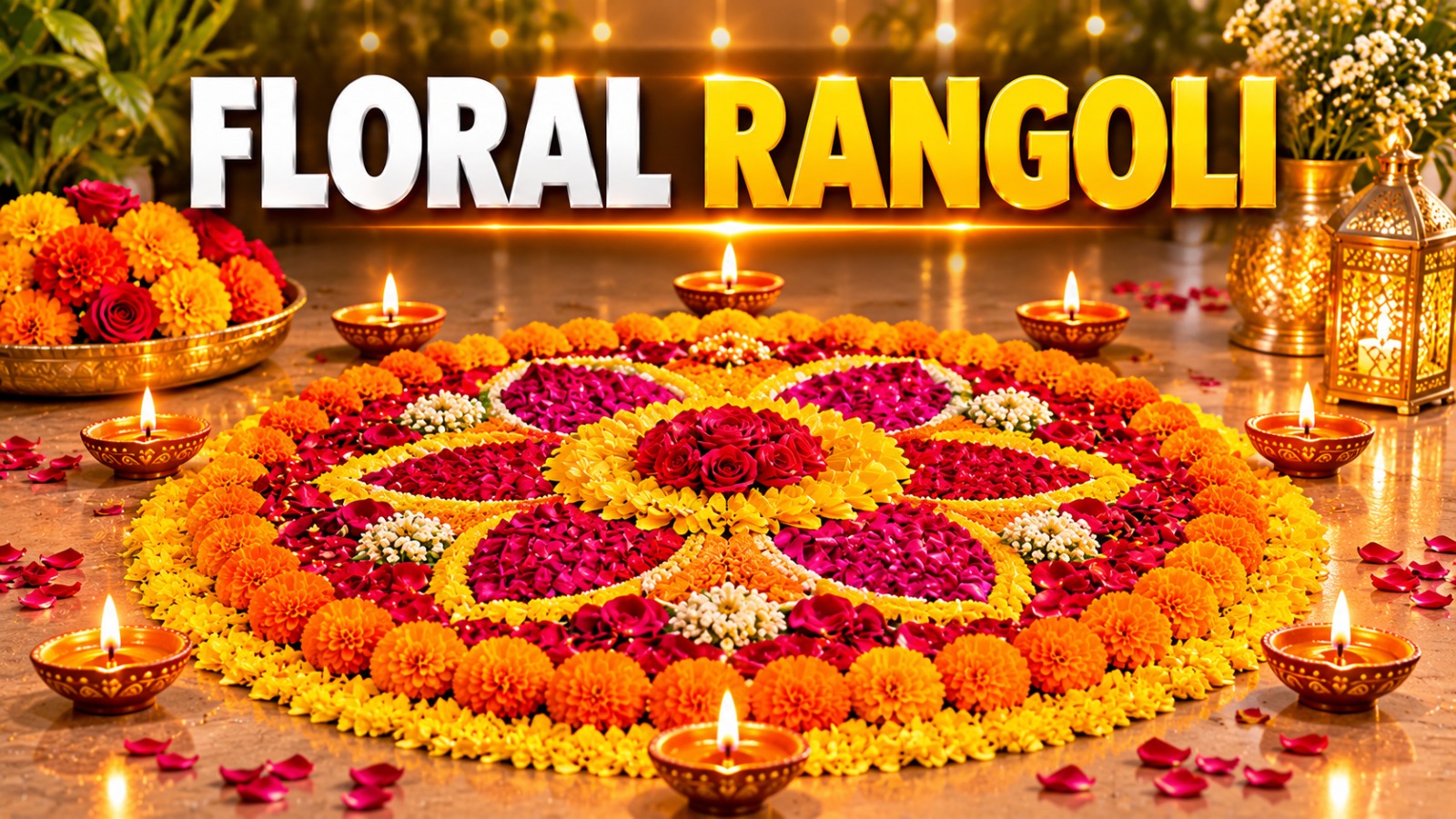
This guide covers rangoli designs for every kind of entrance, from a wide independent-house doorway to a narrow apartment landing, plus how to pair the rangoli with a toran, diyas, and lights so the whole doorway looks complete. For flower-only patterns, see our Diwali rangoli designs with flowers 2026, and for the wider home look, our Diwali decoration ideas at home.
Choosing the Right Entrance Rangoli Design
Start by measuring the space in front of your door. A rangoli should leave at least a foot of clear floor on each side so people can step around it, and the centre of the design should line up with the centre of the door. If the entrance is narrow, a semi-circle that hugs the threshold works better than a full circle, because nobody has to step over it to enter. If the entrance is wide, a full circle with a diya in the middle becomes the natural focal point.
Semi-Circle Designs for Narrow Doorways
The semi-circle is the most practical entrance rangoli design. Draw a half circle with its flat edge against the threshold and its curve facing outward. Fill it with concentric half rings of colour: red on the outside, orange in the middle, yellow near the door. Place three or five diyas along the curved edge. The design takes about thirty minutes with powder and even less with flowers, and guests can walk around it easily because the flat side sits flush with the door.
A variation is the half-mandala, where the semi-circle is divided into petal shapes radiating from the threshold. Each petal can be a different colour, which looks striking and is easy to lay out with a chalk guide. This design photographs beautifully from the front, which is exactly the angle guests see as they arrive.
Full Circle and Diya-Shaped Patterns
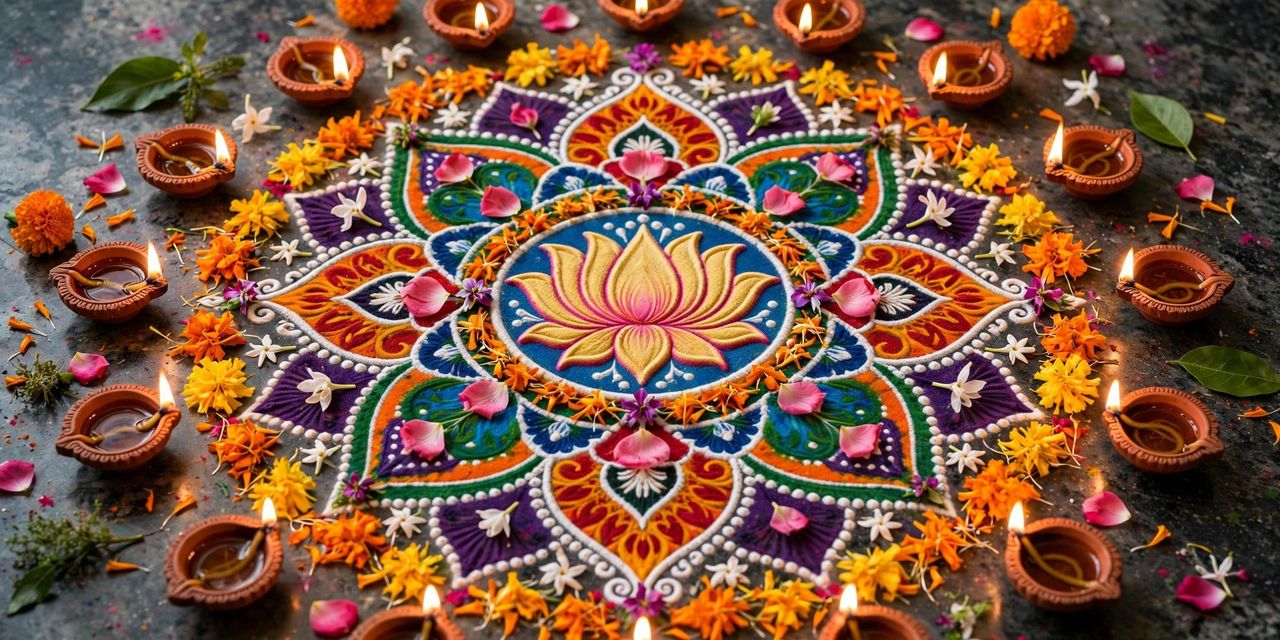
When you have space, a full circle is the classic choice. Build it in rings, place a diya or a small urli with floating flowers at the centre, and add a ring of small diyas around the outside edge. The outer ring of lamps is what makes the design visible after dark, so do not skip it. A diya-shaped rangoli, where the whole pattern is shaped like a lamp with a flame, is a popular alternative for 2026: the lamp body in orange and red, the flame in yellow and white, with a real diya placed at the wick.
Pairing Your Rangoli with a Toran and Diyas
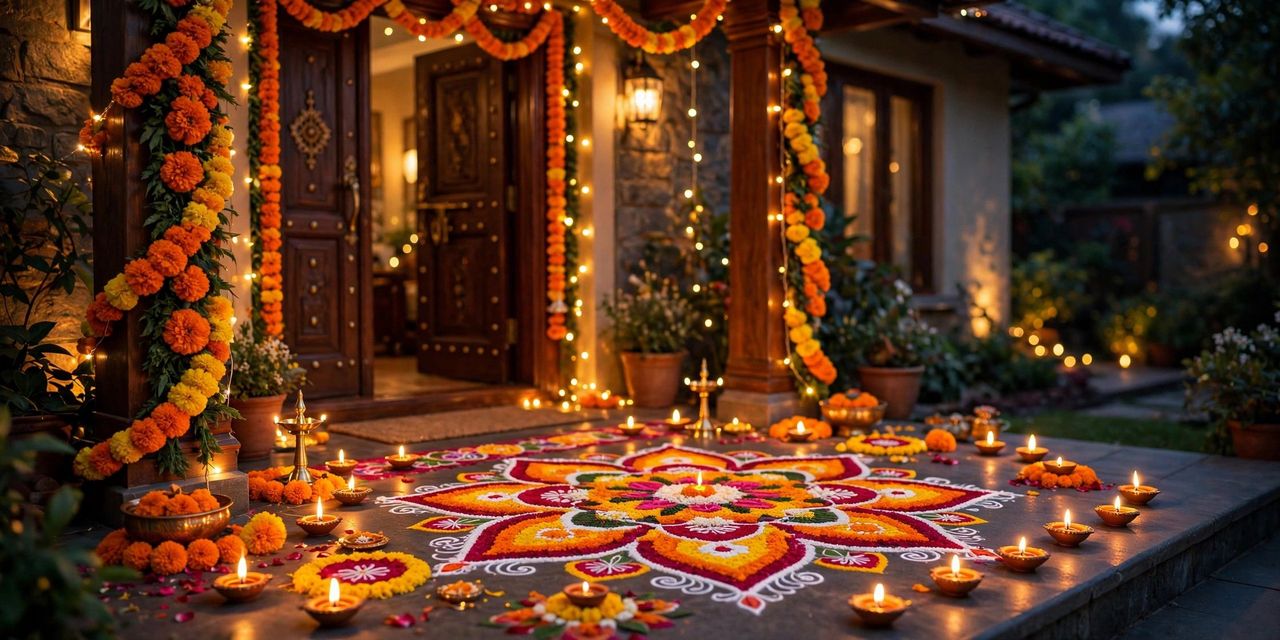
A rangoli on its own is only half the entrance. The toran above the door frames it from above, and the diyas on the steps frame it from the sides. The three together create a complete doorway that feels festive from a distance. Choose one dominant colour for the toran, usually marigold orange, and let the rangoli carry the other colours, so the two do not compete.
Entrance Rangoli Ideas by Home Type
Independent houses with a courtyard can go big: a large circle in the courtyard, a border along the path to the door, and footprints at the threshold. The path border is a lovely touch that guests walk beside, and it needs only two lines of colour with dots between them. Apartments need a smaller approach. A compact semi-circle at the door, a toran above it, and two diyas is enough, and it respects shared corridor space.
For a flat with a balcony entrance, place the rangoli just inside the door on a mat, so it is visible when the door opens but safe from corridor traffic.
Apartment and Small Landing Solutions
Shared landings have real limits: neighbours pass through, children run past, and building rules may restrict what goes on the floor. A rangoli on a wooden board or a large tray solves all of these. Make the design on the board at home, carry it to the door, and bring it inside at night. A board rangoli also survives being stepped on, because it can be repaired on a table and put back out.
Another apartment-friendly option is a rangoli sticker or a reusable rangoli mat, which can be laid in seconds and rolled up after the festival. These are not as personal as a handmade design, but they are practical, and they can be dressed up with real flowers and diyas around the edges.
Step-by-Step: Making an Entrance Rangoli
Clean the entrance area in the morning, on Dhanteras or Choti Diwali, so Diwali day itself is free for the design. On Sunday 8 November, start in the late afternoon, when the sun is low and the floor is cool. Mark the outline with chalk, then fill the colours from the outside in, so you are never leaning over finished work.
- Sweep and wash the entrance floor, then let it dry fully.
- Mark the centre line of the door on the floor with chalk.
- Draw the outline of the design, checking it is centred on the door.
- Fill the outer ring first, then work inward, colour by colour.
- Add dots, leaves, and small details last, when the main shapes are done.
- Place diyas around the edge and the toran above the door.
- Light the diyas at dusk and photograph the entrance before guests arrive.
Keep a small bag of spare powder or petals nearby for repairs. During the evening, check the rangoli once or twice and patch any scuffed corners. A quick touch-up takes a minute and keeps the entrance looking fresh for late guests.
Keeping the Entrance Rangoli Safe and Fresh
Foot traffic is the biggest threat to an entrance rangoli, so place a small shoe rack to one side and ask guests to step around the design. A low rope or a line of diyas along the edge of the design also signals where not to step. Wind is the second threat for outdoor entrances: a light sprinkle of water on a powder rangoli helps it settle, and heavy petals hold better than loose powder on a breezy evening.
Rain is rare on Diwali in most of India, but if the forecast looks uncertain, make the rangoli under a porch or just inside the door. Battery candles are a safer choice than open flames when the design sits near a curtain or a shoe rack. After the festival, sweep the powder rangoli gently and compost the flower petals.
Helpful Finds for Your Entrance
A few lights make the entrance rangoli glow after dark. - a solar fairy light strip can outline the doorway or the garden path, - star fairy lights add sparkle above the door frame, and - a floral battery-operated candle set sits safely beside the rangoli where a flame might be risky.
- Solar Fairy Light Strip Outdoor Garden Decoration Spherical
- 1pc Star Fairy Lights 40 Led Star String Lights
- Led Strip Lights Room
- Floral Battery Operated Candle Set Remote Timer Perfect
As an affiliate, EventBuzz may earn a commission on qualifying purchases at no extra cost to you.
Conclusion
A Diwali rangoli for the door entrance works best when it is centred on the door, framed by a toran above and diyas on the sides, and sized to the space you actually have. A semi-circle suits a narrow doorway, a full circle suits a wide one, and a board rangoli solves the apartment problem entirely. Lay the design on the afternoon of Sunday 8 November, light the diyas at dusk, and keep spare petals or powder nearby for touch-ups. The entrance is where Diwali begins, so give it the care it deserves.
For more ideas, see our Diwali rangoli designs with flowers 2026, rangoli designs for Diwali 2026, and Diwali decoration ideas at home.