Family games live or die on one question: can the youngest player genuinely join in while the oldest still has fun? The christmas games for families in this guide were chosen on exactly that test. They need little or no reading, rounds stay short, luck balances skill so a six-year-old can beat a teenager, and nobody is eliminated to sit and watch — the fastest way to lose a child interest and a grandparent patience at the same time. Each game lists ages, players and supplies so you can build a Christmas Day plan that survives real family energy.
Stock the day from the wider shelves too: our party games guide for more options, family activities for the quiet hours between games, and a scavenger format from our scavenger hunt guide if your crew loves a mission. Keep this guide structure: one active game, one seated game, one whole-room game, repeated as needed.
The All-Ages Rules Every Game Here Follows
Four design rules make family games work. No elimination: players who are out become judges, scorekeepers or teammates, never spectators. Luck plus skill: dice, cards and random draws let younger players win real rounds. Two-minute teaching: if a game cannot be explained during one demonstration round, it waits for a different day. Teams across generations: pairing a grandparent with a grandchild is not just sweet, it balances reading, speed and knowledge so teams compete fairly.
Timing matters as much as choice: play the active game before the big meal or in the fresh air gap after it, keep seated games for the table, and save the calmest game — bingo or a story game — for the evening wind-down. A host who watches energy rather than the clock will time all of this naturally.
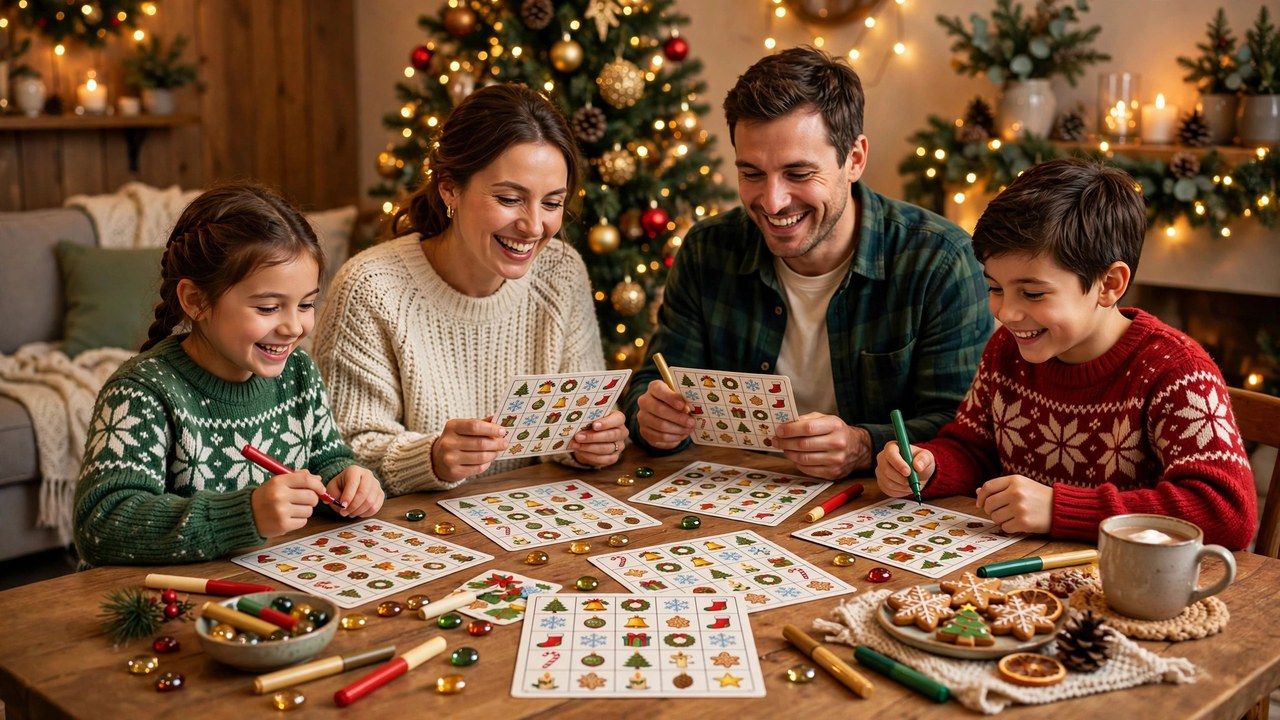
Christmas Bingo: The Whole-Room Classic
Ages 4 and up. Players: any number. Supplies: printed or drawn cards, markers or coins. Cards carry Christmas pictures or words in a grid; the caller draws matching slips from a hat; first to complete a line — then, if energy holds, a full card — calls bingo. Picture cards unlock the game for pre-readers entirely. Our dedicated Christmas bingo guide covers card ideas and variations in full.
Why it anchors family game time: everyone plays simultaneously, grandparents can host as caller, and the pace is gentle enough for conversation to continue between calls. Prizes should be tiny and frequent — a chocolate per line — so several players win across the session and nobody waits an hour for a single payout.
Pin the Nose on Rudolph and Other Little-Kid Winners
Ages 3 to 8. Supplies: a large drawn or printed reindeer face, a red nose with reusable adhesive, a soft blindfold or closed eyes for the youngest. Players take turns placing the nose while gently disoriented; nearest to the target wins the round. Variations keep it fresh for years: pin the star on the tree, the carrot nose on the snowman, or the bow on the present. Keep turns quick, applaud every attempt loudly, and let small children stand closer — adjusting distance by age is fairness, not cheating.
These games look simple because they are, and that is their genius on Christmas Day: zero strategy arguments, total participation, and photograph gold. Pair them with a candy-cane hunt (below) and the youngest guests have a complete games program that never once asks them to read, wait long or lose publicly.
Candy Cane Hunt and Indoor Treasure Trails
Ages 4 and up. Supplies: wrapped candy canes or small treats, hidden in one or two rooms. Hide treats at heights matched to the hunters — low and visible for little ones, cunning for teens — then release everyone with a bag and a five-minute timer. Count the haul together, redistribute so every child ends with a similar share, and crown the finder of one specially marked golden cane. An outdoor version in a garden or porch stretches legs beautifully between courses.
For older kids, upgrade the hunt into a clue trail: each found cane carries the riddle to the next hiding place, ending at a small shared prize. It is the bridge between this guide and our scavenger hunt ideas, and it can be prepared in fifteen minutes the night before with nothing but paper, treats and a little mischief.
Charades and Pictionary, Family Prompts Edition
Ages 6 and up. Supplies: prompt slips, a timer, paper and pencils for the drawing version. Prompts must be actable by a child and guessable by a grandparent: decorating the tree, building a snowman, wrapping a present, a penguin slipping on ice, Santa stuck in a chimney, opening a gift you pretend to love. Teams guess together, turns stay at one minute, and points reward both the actor and the guessing team to keep encouragement high.
Let younger players choose between acting and drawing their prompt — choice is what keeps shy children in the game. Adults should take their turns with full commitment and zero dignity; nothing teaches kids that games are safe like watching a parent mime a reindeer traffic jam with total sincerity.
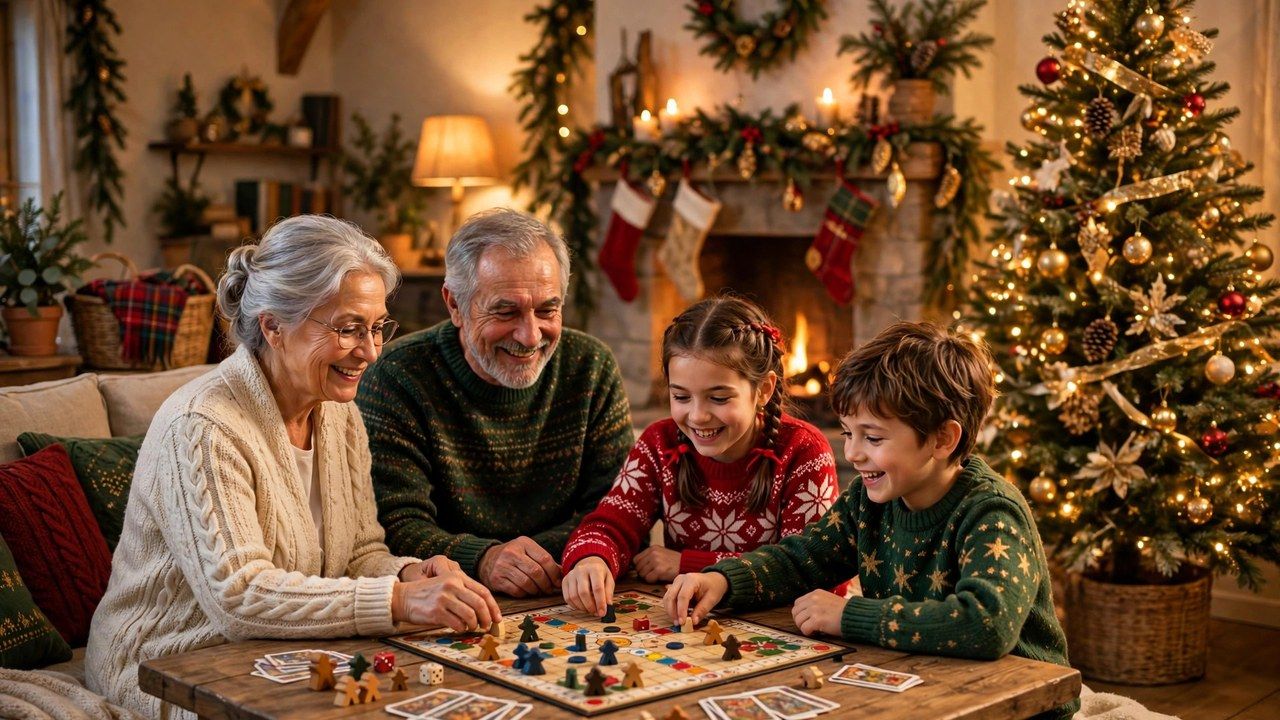
Card and Dice Games the Whole Table Can Play
Ages 5 and up. Supplies: a standard card deck or dice, small counters. Matching and sequencing card games, simple dice race games and the beloved gift-dice circle — where rolling certain numbers passes a shared wrapped prize left, right or across — all teach in one practice round and run on luck enough for anyone to win. Keep counters edible (chocolates, nuts, dried fruit) so winnings are enjoyed and then gone, avoiding both money and hoarding.
Seat a confident player beside the youngest to whisper reminders, and normalize the practice round as part of the game rather than a delay. Families return to these table games year after year precisely because the rules disappear and only the company remains.
Quiet Games for the Evening Wind-Down
Ages 6 and up. Supplies: none, or one phone passed hand to hand. The story-chain game: one person starts a Christmas story with a sentence, each player adds one, and the family record-keeper writes or records the glorious nonsense for next year reading. The memory game — I went to the North Pole and I packed… — adds an item per player and delights in the inevitable collapse around item twelve. A gentle round of the family trivia questions with the easiest round only suits older kids and grandparents together.
Wind-down games protect the best part of Christmas Day: the unhurried hour when nobody wants the day to end. Keep lights low, drinks warm, and competition nearly zero. Tomorrow, nobody will remember scores — they will remember the story about the reindeer who packed a swimming costume, word for word.
Prizes, Fairness and Honest Notes for Parents
Prize philosophy for families: small, edible, frequent and roughly equal by the end of the day. Keep a hidden reserve of treats to balance outcomes quietly — the goal is every child remembering a win, not an audit of justice delivered in public. Rotate who goes first, who calls bingo and who judges costumes, because roles are prizes too.
Pros of a planned family games hour: screens go down without a battle, generations actually interact, and the day gains a shape children anticipate yearly. Cons to manage: competitive tears (solve with teams and luck), adult over-coaching (solve with a smile and a house rule), and games that run long (solve with rounds, timers and a snack break). When adults need their own later round, our games for adults guide takes over after bedtime.
Conclusion
Family Christmas games succeed when everyone can play, anyone can win and nobody sits out. Build the day from bingo, one active hunt or pinning game, charades with kind prompts, a luck-based table game and a quiet story game to close — then watch the generations mix exactly the way Christmas promises they will.