A full Christmas feast does not require a frightening grocery bill. It requires a plan: one affordable centerpiece cooked well, sides built from inexpensive staples at their best, and a shopping strategy that refuses to pay full price for atmosphere. This guide to Christmas dinner on a budget gives you a complete menu, a roast chicken feast with all the trimmings, plus the cost-saving approach in general terms, because smart principles travel better than any single store price.
A note on honesty: this guide does not quote specific grocery prices, because they vary by store, region and week, and last years numbers help nobody. Instead you get the strategy that works at any prices, and a menu designed around ingredients that are reliably among the most affordable in the store. For the unrestricted version of the feast, see our Christmas dinner menu guide.
The Budget Menu, Complete
| Course | Dish | Why it earns its place |
|---|---|---|
| Main | Herb roast chicken with pan gravy | Whole chicken is the most affordable roast centerpiece in most stores |
| Side | Crispy roast potatoes | Potatoes are inexpensive and everyone loves them done well |
| Side | Honey glazed carrots and parsnips | Root vegetables are cheap, sweet and festive |
| Side | Sage and onion stuffing | Mostly bread: pennies of cost, mountains of flavor |
| Side | Buttered frozen peas with mint | Frozen peas are affordable, bright and impossible to ruin |
| Sauce | Cranberry sauce | One bag of cranberries, sugar and an orange |
| Dessert | Bread and butter pudding | Turns stale bread and store-cupboard staples into dessert |
Every ingredient on this list is a supermarket staple, available in store brands, and most appear in holiday promotions. That is the menu design working before you spend anything.
The Centerpiece: Herb Roast Chicken
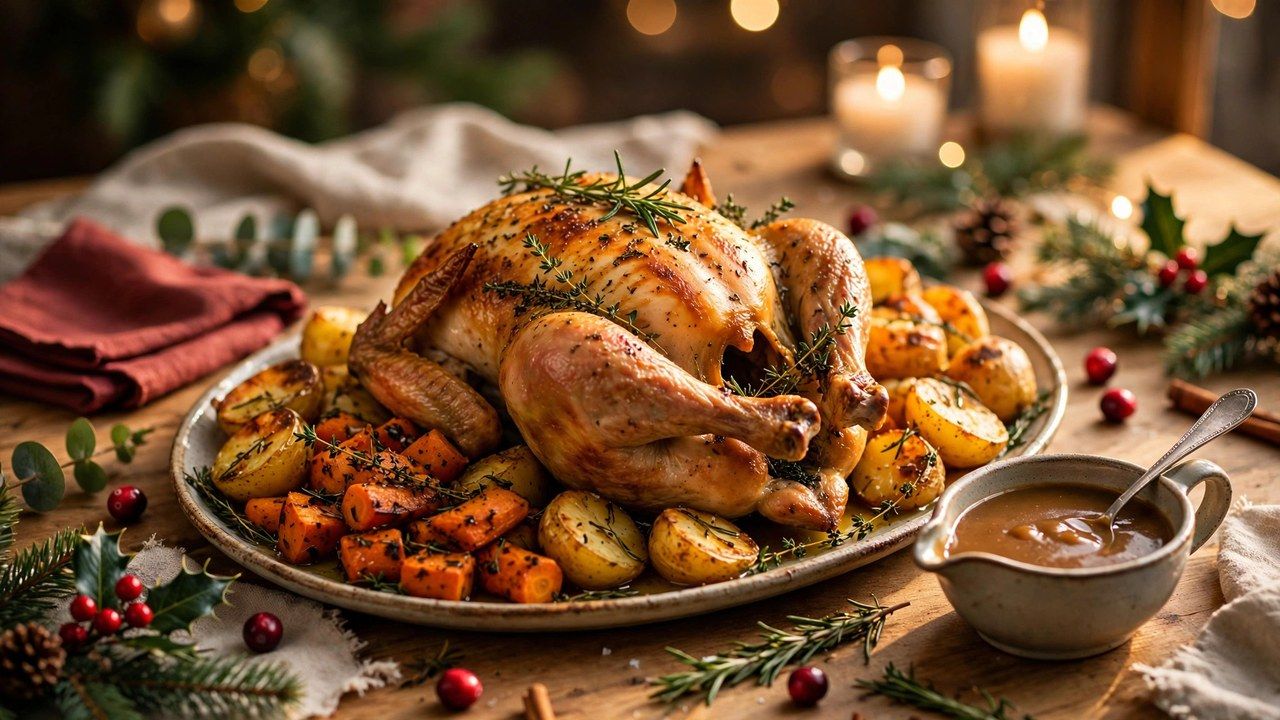
For four to six people, choose a whole chicken of about 4 to 5 pounds. Pat it dry, rub it all over with softened butter or oil mixed with salt, pepper, garlic powder and dried sage or thyme, and tuck half a lemon and a halved onion inside. Roast at 425°F (220°C) for 20 minutes, then reduce to 375°F (190°C) and roast about 20 minutes per pound in total, until the thickest part of the thigh reads 165°F (74°C) and the juices run clear. Rest it, tented, for at least 15 minutes before carving.
Make the gravy from the pan: pour off all but 2 tablespoons of dripping, whisk in 2 tablespoons flour and cook 1 minute, then whisk in 2 cups of chicken stock (from a cube is fine) plus the resting juices, simmering until it coats a spoon. Season boldly; gravy is where a budget roast tastes expensive. Two smaller chickens beat one giant bird if your group is larger, because they cook evenly and carve easily. A sturdy pan like the one in our shop pick handles the stovetop gravy and the glazed vegetables without complaint.
Sides That Taste Like Money
Roast potatoes: peel and chunk 3 pounds potatoes, parboil 8 minutes in salted water, drain and shake in the colander to rough the edges, then roast in a thin layer of hot oil at 425°F (220°C) for 45 to 55 minutes, turning once, with salt at the end. Rough edges are free crispiness. Glazed roots: cut 1 pound each carrots and parsnips into batons, roast with oil and salt at 400°F (200°C) for 30 minutes, then toss with a spoon of honey for the final 5. Stuffing: soften a chopped onion and celery stalk in butter, mix with 6 cups of torn stale bread cubes, a teaspoon of dried sage, salt, pepper and enough stock to moisten, and bake in a dish at 375°F (190°C) for 30 minutes until crisp on top.
Peas: simmer a bag of frozen peas for 2 minutes and toss with butter and torn mint or parsley. Frozen peas are picked and frozen at their sweetest, which is why chefs defend them; they are a quality choice disguised as a cheap one. Cranberry sauce: simmer 12 ounces cranberries with 3/4 cup sugar and the juice and zest of an orange for about 10 minutes until the berries pop; it sets as it cools and can be made days ahead.
Dessert: Bread and Butter Pudding
Butter 6 to 8 slices of day-old bread, cut them diagonally and layer them in a greased dish with a scattering of raisins or any dried fruit you have. Whisk 2 cups milk, 2 eggs, 1/4 cup sugar, 1 teaspoon vanilla and a pinch of cinnamon, pour over the bread, rest 20 minutes so it soaks, then bake at 350°F (175°C) for 30 to 35 minutes until puffed and golden. Serve warm. The entire dessert is built from bread, milk and eggs, which is precisely the point.
If bread pudding is not your family tradition, a simple apple crumble uses the same economics: fruit that needs using, a rubble of flour, butter and sugar on top, and the oven that is already warm. Our Christmas dessert recipes collection has more ideas at every budget, and our Christmas cake ideas guide includes the loaf cakes that cost least per slice.
The Cost-Saving Strategy, in General Terms
Plan the menu before the store does. Write the menu, then the list, and shop the list only. Buy the centerpiece on promotion and freeze it if the deal appears early; whole birds and chickens are among the most heavily promoted items of the season. Shift brands without shame: store-brand staples like flour, stock, frozen vegetables and dairy are where the quiet savings live, while you keep quality where it shows, in butter and the main dish seasoning. Use frozen where frozen is better: peas are the famous case, but frozen fruit for sauces and desserts also beats out-of-season fresh on both price and flavor.
Cook from the pantry first. Design one or two dishes around what you already own before writing the list. Let guests bring drinks or a dessert if they offer; a potluck element is a tradition, not a confession. Watch unit prices, not package prices, and be suspicious of festive packaging, which charges a premium for red cardboard around the same product. None of this requires coupons, apps or heroics; it is simply deciding before the store decides for you.
A Simple Timeline That Protects the Day
| When | Task |
|---|---|
| 2–3 days before | Make cranberry sauce; buy everything; thaw the chicken safely in the fridge if frozen |
| Day before | Make the stuffing base; peel vegetables into water; set the table |
| Morning | Assemble the bread pudding (refrigerate unbaked); prep the chicken |
| About 2 hours before | Chicken goes in; potatoes parboiled and ready |
| 45 minutes before | Potatoes and roots into the oven around the chicken schedule |
| While chicken rests | Stuffing bakes, gravy is made, peas are heated |
| After dinner | Bread pudding bakes while you clear, using the warm oven |
One oven, sequenced honestly, is enough. The pudding baking during dinner is the oldest budget trick in the book: the heat was already paid for.
Leftovers: The Second Feast You Already Bought
Budget cooking does not end at the table; the leftovers are where the menu pays you back. Carve all remaining chicken off the bone the same evening. The bones simmer with an onion, a carrot and water for about an hour into stock for soup. Leftover chicken becomes sandwiches, a pie with the remaining vegetables under a simple pastry or mash lid, or a fried rice. Leftover roast potatoes crisp again in a hot pan, stuffing fries into cakes for breakfast, and cranberry sauce livens sandwiches for a week.
Plan for these second meals when you shop and the feast stops being one expensive day and becomes three days of eating that happened to start with a celebration. That reframing, more than any single saving, is how experienced budget cooks think.
Honest Pros and Cons of the Budget Feast
Pros: dramatically lower cost per plate, a shopping list of ordinary staples, leftovers that keep giving, and food that tastes like a classic Christmas rather than a compromise. Cons: chicken needs more carving attention than a boneless roast, the savings depend on planning a few days ahead, and a very large group needs two birds and confident oven scheduling. If your group prefers turkey, the same strategy applies: buy it on promotion, freeze early, and let the same cheap, brilliant sides carry the table.
What a budget feast should never cut is seasoning, rest time and gravy. Those three cost almost nothing, and they are most of the difference between food that feels cheap and food that feels generous.
Conclusion
A full feast without the panic bill is a planning achievement, not a sacrifice: an affordable bird roasted properly, sides built from the cheapest ingredients in the store cooked at their best, a dessert made from bread and milk, and leftovers planned like a second menu. Write the list, shop the promotions, season boldly, and sit down to a table nobody would call a compromise.