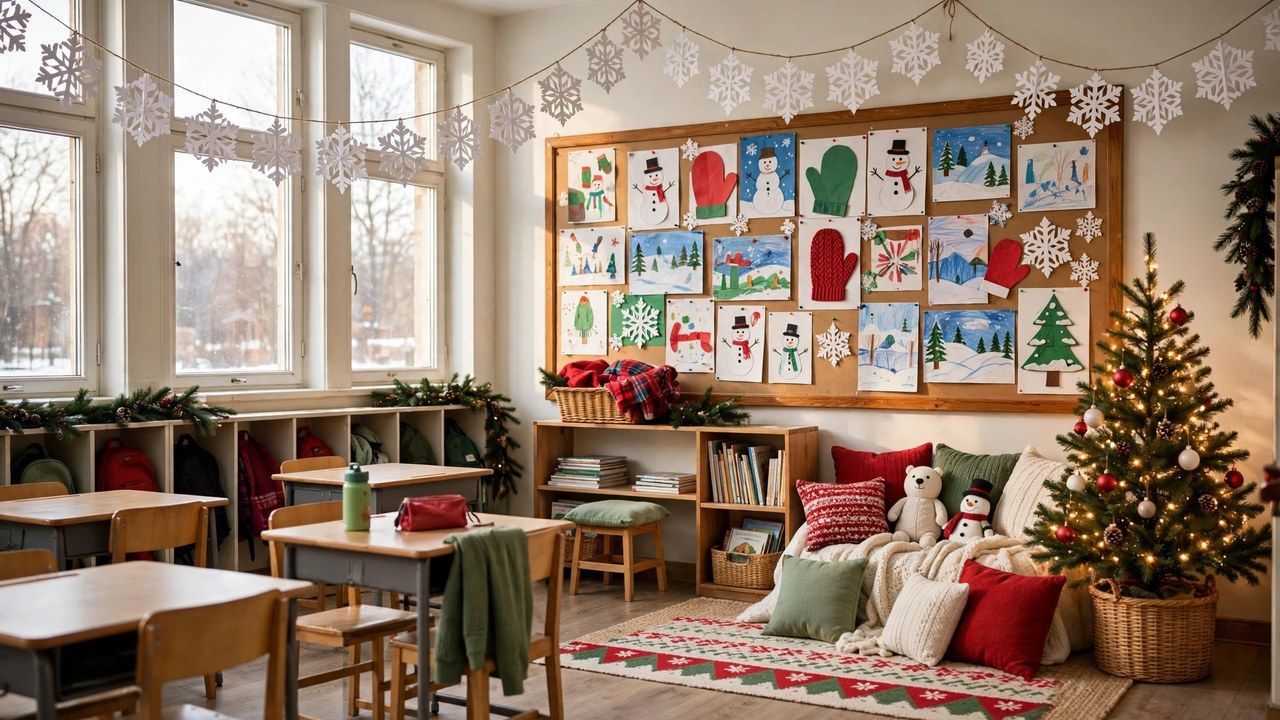
Classroom decorating is a balancing act no home decorator faces: the room must feel magical for children, calm enough to learn in, inclusive of every family’s traditions, and compliant with school safety rules, all on a teacher’s budget and Sunday afternoon. The best christmas classroom decor leans on student-made work, paper and light rather than store-bought spectacle, because a room decorated by its class feels like theirs. This guide covers boards, doors, windows and reading corners with inclusion and practicality built into every idea.
If you are decorating for children at home too, our Christmas family activities guide has the companion projects, and our DIY Christmas decorations guide is full of paper crafts that transfer directly to a classroom. Everything below is designed to go up fast, stay up safely, and come down in January without damaging walls a custodian will thank you for respecting.
Inclusion First: Festive Without Leaving Anyone Out
Start from the principle that December belongs to every child in the room. Lead with winter imagery, snow, stars, light, kindness and gratitude, which every family can share, and treat Christmas-specific symbols as part of a broader seasonal display rather than the whole room. Many teachers pair the display with a simple look at how different cultures celebrate light and generosity in winter, which turns decor into a gentle lesson instead of a statement.
Follow your school and district guidance, which always outranks any decor guide, and keep religious instruction out of a public classroom display. Student work is your safest and best material: when the walls show what the class made, every child sees themselves in the room regardless of what their family celebrates at home. Kindness chains, gratitude garlands and winter writing displays carry the festive feeling with universal content.
Bulletin Boards That Do Double Duty
The bulletin board is your biggest canvas, so make it earn its space by teaching something. A winter reading board where each book read adds a snowflake or a light to a string, a math board with a snowman built from solved problems, or a writing board of winter poems all decorate and document learning at once. Back the board in a deep blue or classic red paper, border it with a paper garland the class made, and the room’s festive center is done in one afternoon.
Keep one board purely celebratory for student work that deserves display, rotating pieces so every child appears. Paper chains and cut-paper borders are the classroom classics because they are free, repairable and made by the students themselves. Our paper snowflake guide gives you the folds for a board border or window display that looks genuinely impressive.
Door Decor: The Hallway Handshake
The classroom door is the one surface the whole school sees, so it is the place for your boldest, simplest design: a snowman built from three paper circles with student-named carrot wishes, a giant gift wrap design with a bow, or a winter scene the class assembles piece by piece across the month. Big shapes read from down the hall; small details reward the children who pass close. Keep the design flat to the door and fully inside its edges so nothing catches on passing traffic.
Check your school’s rules before covering a door: many fire codes limit how much of a door and its window can be covered, and the window in the door often must stay clear. Use the approved adhesives your school allows, usually painter’s tape or reusable putty, and test on a hidden corner. A door that wins the hallway and peels the paint is a loss.
Windows, Ceilings and the Safety Rules
| Element | Classroom-safe approach | Avoid |
|---|---|---|
| Window displays | Paper snowflakes, clings, student art taped at edges | Blocking light or emergency visibility |
| Ceiling hanging | Lightweight paper items, only where school rules allow | Anything over exits, sprinklers or detectors |
| Lights | Battery fairy lights in jars, teacher-controlled only | Extension cords across floors, personal plug-in strings if unapproved |
| Scent and food decor | Unscented, allergy-aware displays | Scented items, food-based crafts in allergy classrooms |
When in doubt, ask the custodian and check the staff handbook; schools differ, and the rules exist because classrooms are crowded, high-energy spaces. Nothing should hang where it can fall onto a child, block a sprinkler or detector, or trail near a heater. Keep walkways and the area around the door completely clear, and secure every paper edge so December’s drafts do not redecorate for you overnight.
Student-Made Decor: The Heart of the Room
A classroom decorated by its students teaches ownership along with cutting skills. Paper chains measured for a math lesson, handprint wreaths for the youngest classes, snow globes drawn and written about, and a kindness garland where each link records a good deed all cost almost nothing and mean more than anything store-bought. Display the making, not just the results: a slightly crooked chain made by twenty-five children is the most festive object in any school.
Build decorating into the timetable honestly rather than stealing learning time wholesale: a craft Friday afternoon, a writing-linked project, a measurement activity disguised as garland production. Families who can contribute can send in paper and supplies, but design every project so the school or teacher provides the materials and no child needs anything from home to take part fully.
The Reading Corner and Calm Zones
Every classroom needs the festive volume turned down somewhere. The reading corner is where a small paper tree, a string of battery lights in a jar, soft winter cushions and a basket of seasonal books create a cozy retreat that still supports the calm some children desperately need in December’s excitement. Keep this zone decoration-light by design and say so; choice is part of inclusion.
Seasonal books deserve the same inclusive eye as the walls: winter stories, tales from many traditions, and class favorites with snow on the cover. A countdown of books, one unwrapped each school day of December, turns the corner into the room’s most anticipated ritual. Our Christmas books for kids guide can help you build the basket.
Teacher-Friendly: Budget, Time and Takedown
The teacher-friendly test is three questions. Can I afford it from my own pocket without resentment, ideally under the cost of a pizza, using paper, the school laminator and what the class makes? Can I put it up in one prep period with a stapler and tape? Can I take it down in January in twenty minutes and store it in one box or reuse it as art portfolios and writing covers? Any decoration failing two of the three is a Pinterest promise, not a plan.
Photograph your room before takedown and keep a one-line note of what worked; next December you will be grateful. Reusable bones, a good backing paper roll, laminated borders and a class set of snowflake templates, carry from year to year, while the student-made layer is proudly new every time.
Honest Pros and Cons of a Fully Festive Classroom
Pros: a decorated room lifts December morale, gives student work an audience, and turns the longest-feeling month of the term into a shared project. Cons: overstimulation is real for some children, decor costs fall on teachers, and every display is future takedown labor. The balanced classroom decorates generously at the walls and door, keeps desks and calm zones clear, and lets the children’s own work do the heavy lifting, which is the most festive outcome anyway.
Involving Families Without Adding Pressure
Families often want to help, and the kindest way to let them is a short, specific, optional list: spare paper, tape, or an hour of cutting snowflakes at home for the window display. Keep every request free or nearly free, make clear that nothing is required, and never let a child’s participation in the room’s display depend on what came from home. A class collection box for shared supplies keeps contributions anonymous and equal.
Thank contributors publicly as a group and privately as individuals, and send the student-made decorations home at the break as the family keepsake they already are. The goodwill built by that simple loop, families included without pressure, children proud of a room they decorated themselves, is worth more than any display a teacher could buy, and it is the real curriculum hiding inside December decorating.
Conclusion
Decorate the classroom the way you teach in it: generously, inclusively and with the students’ work at the center. Paper, light and kindness themes carry the whole season safely, the door and one great board do the showing off, and a calm corner keeps December kind for every child in the room.