Ask ten people their favorite Thanksgiving dish and stuffing wins more votes than the turkey itself. It is savory, comforting, endlessly customizable, and the rare side dish that doubles as a leftover hero. But stuffing has strong opinions attached: in the bird or in a pan, soggy or crispy, classic or creative. This guide covers the great debate, the perfect classic recipe, and nine variations, so whatever your family's stuffing politics, dinner ends in agreement.
Stuffing vs. Dressing: The Great Debate
Technically, stuffing is cooked inside the bird and dressing is baked separately in a pan, though most Americans use the words interchangeably and geography decides which one you say. The practical difference matters: stuffing cooked in the turkey absorbs drippings and tastes incredible, but it must reach 165°F at its center to be food-safe, which often means overcooking the breast meat around it. That is why most chefs now recommend baking it separately as dressing.
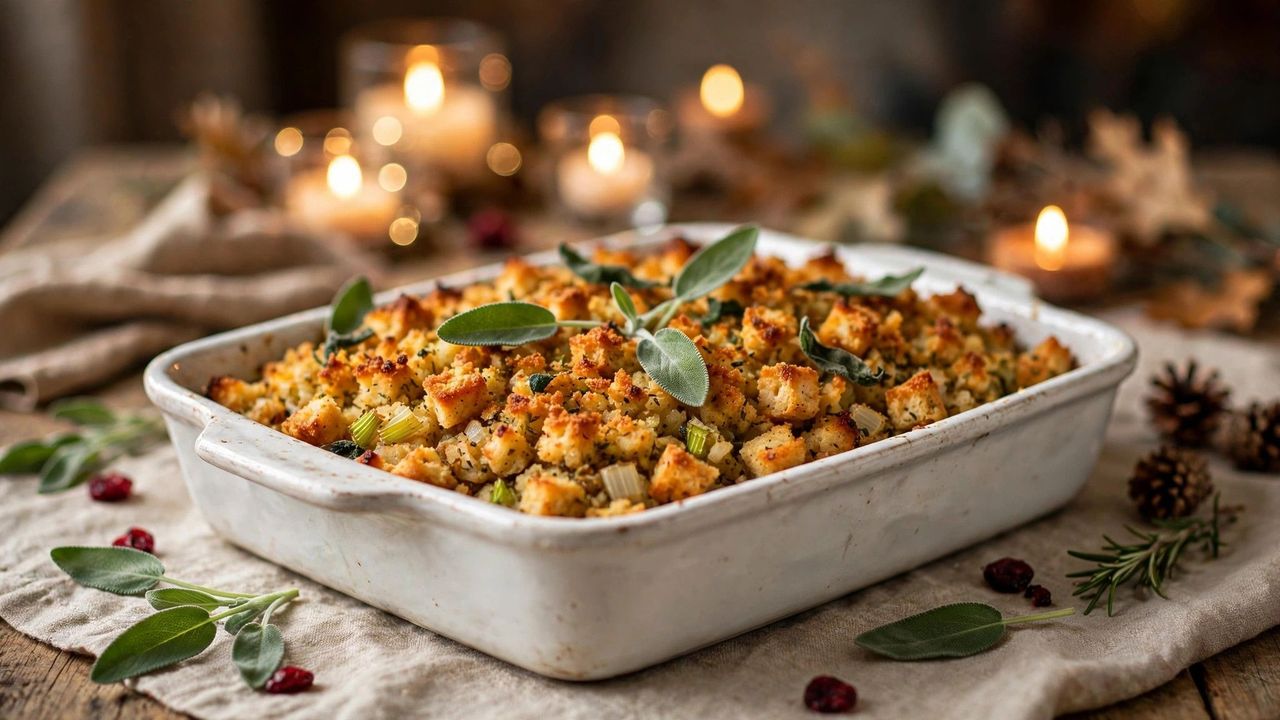
Baking in a pan gives you something the bird never can: crispy, golden edges. A 9x13 pan of dressing has maximum surface area for browning, and those crunchy bits are what people fight over. If you miss the drippings flavor, stir a few spoonfuls of turkey drippings or rich stock into the dressing before baking. You get the best of both worlds with none of the food-safety anxiety, which is why every recipe below is written for the pan.
The Classic: Sage and Onion
The perfect classic starts with the bread. Use day-old bread, torn or cut into 3/4-inch cubes and dried in a 300°F oven for 20 minutes. Stale bread absorbs stock without turning to mush; fresh bread dissolves into paste. A sturdy white sandwich loaf, challah, or a mix of white and cornbread all work beautifully. You need about 12 cups of cubes for a 9x13 pan that serves 10 to 12.
Saute 2 diced onions and 4 diced celery stalks in half a cup of butter until soft, then add 2 tablespoons of chopped fresh sage, a tablespoon of thyme, and salt and pepper. Toss with the bread cubes, then pour over 2 to 3 cups of warm turkey or chicken stock mixed with 2 beaten eggs; the eggs bind everything and add richness. The mixture should be moist but not swimming. Bake covered at 375°F for 30 minutes, then uncovered for 20 more until the top is deeply golden and crisp.
Five Creative Twists
Cornbread and sausage dressing is the Southern icon: crumbly cornbread, browned breakfast sausage, and a little cayenne, bound with stock and baked until the edges caramelize. Wild mushroom dressing swaps in roasted cremini and shiitake mushrooms with fresh thyme and a splash of sherry for an earthy, elegant version that vegetarians can enjoy with vegetable stock. Apple and walnut dressing adds diced tart apples, toasted walnuts, and a pinch of cinnamon for a sweet-savory balance that loves pork and turkey alike.
Oyster dressing is the old-school coastal classic: briny oysters folded in during the last 10 minutes of the vegetable saute, with extra celery and a dash of hot sauce. Chorizo and cornbread brings smoky Spanish chorizo, roasted poblanos, and cilantro for a version with real kick. For something truly different, try sourdough dressing with roasted chestnuts and pancetta, or a wild rice and cranberry dressing that is naturally gluten-free and gorgeous on the table.
The Crispy-Top Technique
The difference between good dressing and unforgettable dressing is texture contrast: creamy interior, shatteringly crisp top. These rules guarantee it:
- Do not over-wet. The bread should be evenly moist, not soggy. Add stock gradually; you can always add more, but you cannot remove it.
- Bake uncovered at the end. Cover for the first 30 minutes to cook through, then uncover for 20 to 25 minutes for browning.
- Dot with butter. Small pieces of cold butter scattered over the top before the uncovered bake create extra-crisp, golden patches.
- Finish under the broiler. 2 to 3 minutes under a hot broiler at the very end gives a crackling crust. Watch it like a hawk.
- Rest 10 minutes. Dressing sets as it cools slightly, making it easier to scoop and keeping the interior creamy.
Make-Ahead and Food Safety
Assemble the dressing completely up to 2 days ahead, cover tightly, and refrigerate unbaked. Add 10 to 15 minutes to the covered baking time when cooking from cold. Do not combine the wet and dry components more than 2 days ahead, or the bread can get gummy. Baked leftovers keep 3 to 4 days refrigerated and reheat beautifully covered with foil at 350°F, with a splash of stock to refresh them.
If you insist on stuffing the bird, follow the safety rules: stuff loosely (3/4 cup per pound of turkey), stuff just before roasting, never in advance, and verify the center hits 165°F with a thermometer. Honestly, though, bake it separately and spoon a ladle of hot drippings over the top before serving. Nobody will know the difference, and the turkey will cook more evenly too.