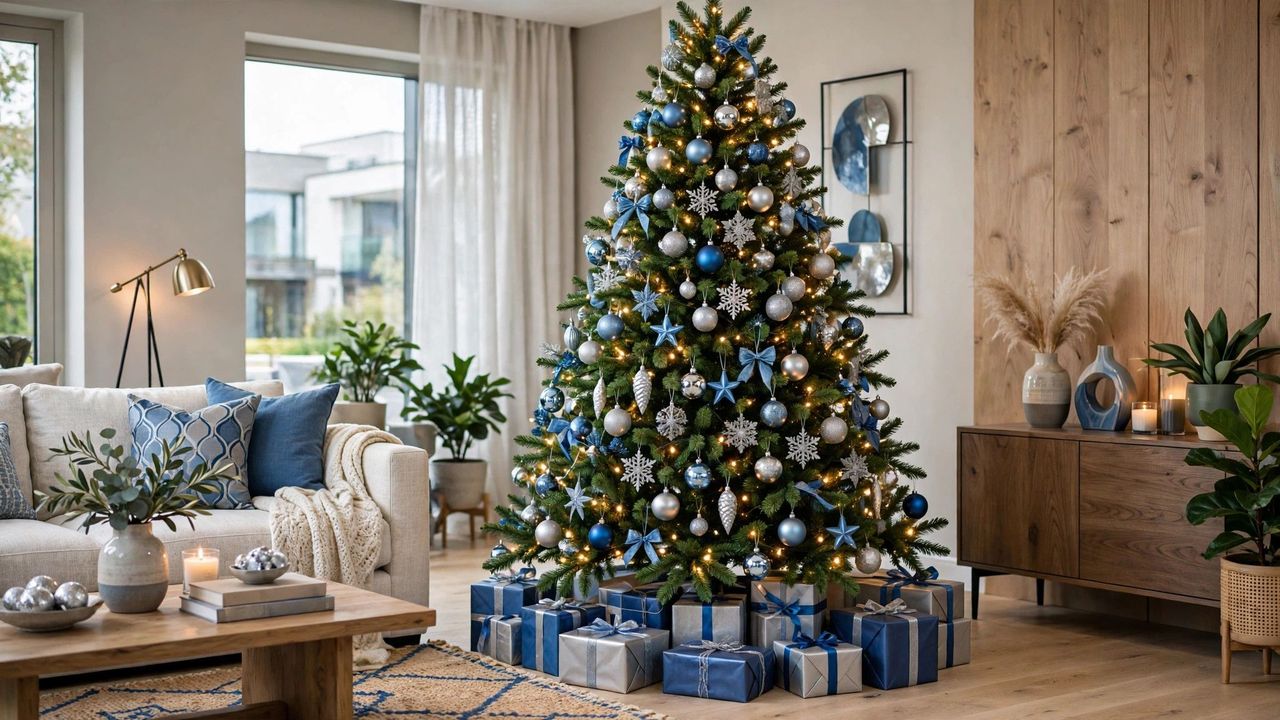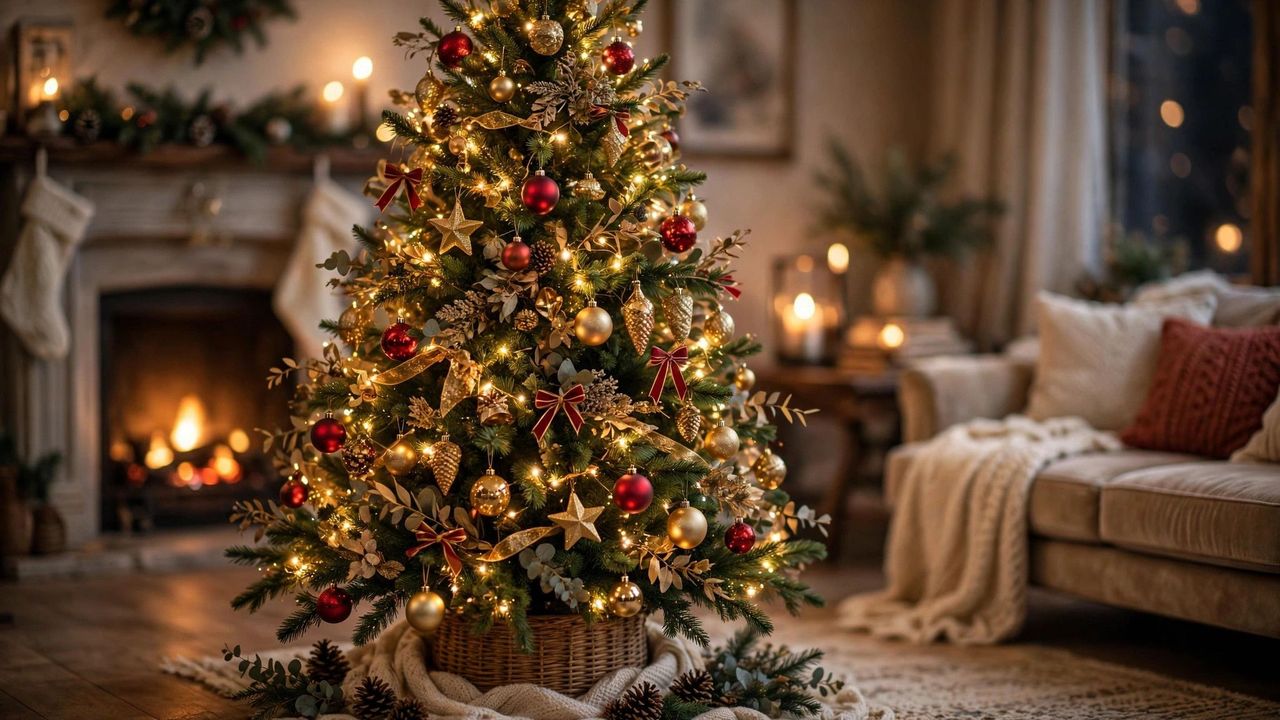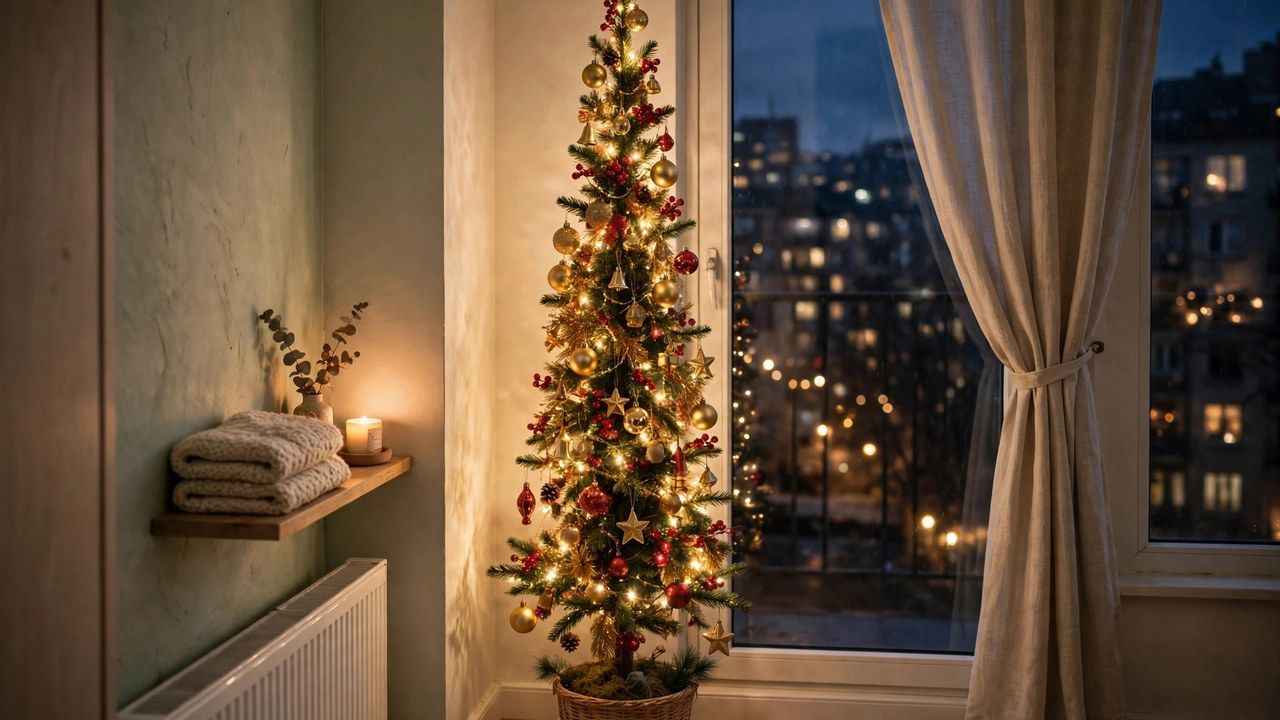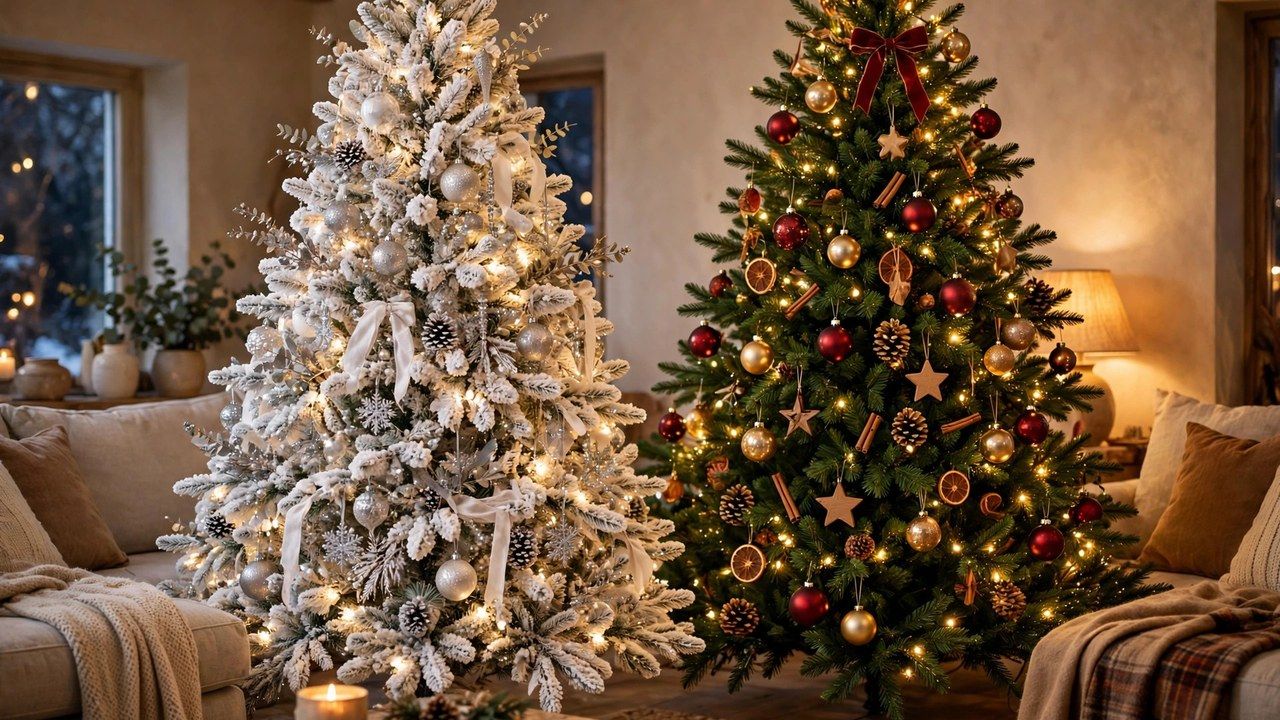
Stand in any tree showroom in November and the choice announces itself from across the floor: the white dusted trees glowing like a snowfall scene, and the deep green traditional trees beside them. Flocked vs unflocked christmas tree is not a question with a universal right answer. It is a question about your room, your tolerance for mess, who lives in your house, including the four legged members, and how you like to decorate. This guide compares the two honestly, factor by factor, and ends with a verdict framework you can apply in about thirty seconds.
Whichever way you land, the buying fundamentals in our artificial tree guide and the styling in our tree decorating ideas apply to both finishes, and slim profiles of either type are covered in our slim and pencil trees guide.
What Flocked Actually Means
Flocking is a white, snow effect material applied to the branches of a real or artificial tree so it looks freshly dusted, or in heavier versions, deeply snow laden. On artificial trees it is applied during manufacture in light, medium or heavy grades. On real trees it is applied by sellers or, messily, at home. The effect transforms the color of the tree itself: green becomes a supporting shade under white, which changes everything downstream, from which ornament colors shine to how the tree photographs and how much light it seems to give back to the room.
Unflocked simply means the tree in its natural or manufactured green, from pale fir tones to deep spruce. It is the default finish, the one ornaments were historically designed against, and the one with no extra material to shed, ingest or react to.
Head to Head: The Full Comparison
| Factor | Flocked | Unflocked |
|---|---|---|
| Look | Winter scene, bright, photographic, modern classic | Traditional, deep, natural, timeless |
| Effect on room | Lightens and cools the space; suits dark rooms | Adds depth and warmth; suits bright rooms |
| Cost | Usually more for the same size and quality | Widest range, including the best value options |
| Mess | Sheds some flock at setup, dressing and packing | Needle style shedding only, on artificial; real trees shed needles |
| Allergies and sensitivities | Extra material and dust; check household sensitivities | Simpler material profile; real trees carry their own pollen and mold considerations |
| Pets and small children | Flock can be nibbled or knocked loose; supervise and consider placement | No coating to ingest; standard tree safety still applies |
| Decorating | Needs fewer, bolder ornaments; pastel and metallic shine | Carries any ornament style and full traditional loads |
| Storage | Wants a bag; compression rubs flock over years | Tolerates standard boxes and compression better |
The Look, In Real Rooms
Flocked trees dominate photographs for a reason: white branches catch and scatter light, faces beside them look bright, and the whole scene reads winter even in a sun belt living room where snow is a rumor. In person the effect is softest and most luxurious with a light to medium flock, where green still shows and the tree reads dusted rather than painted. Heavy flocking is a stronger commitment: striking in a minimal or white room, but it can look flat in a beige one, because tree and walls converge in tone.
Unflocked green is the finish that supports every other decorating decision. Red and gold at full traditional strength, collections of ornaments gathered over decades, colored lights, heirloom pieces of every era: all of it was designed against green. Green also hides the small imperfections of a lived in tree, a dropped ornament hook, a bare patch, in a way a white surface cannot.
Cost and Value Over the Tree's Life
At the same size and build quality, flocked artificial trees generally cost more, because flocking is an extra process and a selling feature. The value question is lifespan. A well stored unflocked artificial tree can look correct for many seasons with almost no visible aging. A flocked tree slowly loses flock at friction points each time it is assembled, dressed, undressed and stored; after several seasons the loss shows first at the branch tips you handled most, and heavy flock styles show it sooner.
That does not make flocked a bad buy. It makes it a buy with a realistic horizon: if you love the look, price it across the seasons you will genuinely use it, and handle and store it gently to reach the long end of its range. Buying the heaviest flock at the lowest price is the combination most likely to disappoint by year three.
Mess, Allergies, Pets and Children: The Household Factors
Expect some flock fallout. Setup day will put white dust on the floor and on your clothes, dressing the tree sheds a little more, and a curious cat can distribute it creatively. It vacuums up easily, but households that find glitter a moral failing should consider themselves warned. People with dust sensitivities may notice flocked trees, especially in the first days after setup; running the tree's assembly outdoors or in a garage, and giving branches a gentle shake before bringing the tree in, reduces the loose material considerably.
For pets and toddlers, the honest position is caution rather than alarm. Flocking materials vary, animals should not be eating any part of an artificial tree, flocked or not, and a flocked finish gives a determined chewer more to ingest and more visible damage when they try. If your household includes a pet in its oral exploration phase, an unflocked tree, securely anchored, with decorations kept above reach height, is the simpler risk decision. The same anchoring advice appears in our wider safety notes in the tree buying guide.
Decorating Each Finish
- On flocked: Go fewer and bolder. Metallics, deep red, navy and blush all read clearly against white; small pale ornaments disappear. Ribbons and picks in one accent color outperform a full mixed load. Warm lights keep the white creamy rather than blue.
- On unflocked: Everything works, including the full traditional program of layered garlands, mixed ornaments and collected pieces, as in our tree themes guide. Green is also the finish for multicolored lights, which fight a white flocked surface.
- Shared rules: Test a branch's worth of your scheme before committing the whole tree, and photograph it. Cameras find tone problems your eyes forgive.
The Verdict Framework
Answer three questions. First, your room: is it dark or low light, and would a brightening, wintry focal point lift it? Point to flocked. Is it already bright, warm and traditional? Point to unflocked. Second, your household: any dust sensitivities, chewing stage pets or toddlers, or a strong anti mess vote? Point to unflocked. Third, your decorating style: do you love a curated, photogenic scheme you refresh in a direction each few years? Flocked rewards you. Do you hang thirty years of collected ornaments and want them to be the story? Unflocked, unambiguously.
Two points or more decides it, and there is an honorable compromise used by many two tree households: the flocked tree as the formal, photographic tree, and an unflocked tree, perhaps smaller or in a family room, carrying the collected ornaments and the children's decorating. Each finish then does the job it is genuinely best at.
What About Real Trees in Each Finish?
Most of this comparison concerns artificial trees, but real trees come in both finishes too, since many lots offer flocking on a fresh cut tree. A flocked real tree gives the most convincing snow effect of all, because real branches carry flock unevenly in a natural way, but it adds cost to a tree you will recycle in January, and the flock complicates that recycling: many municipal programs will not take flocked trees for mulching, so check your local rules before choosing it. Flocking also seals the needles slightly, which some sellers claim slows drying; the safer claim is simply that a real tree of either finish still needs its water checked daily.
An unflocked real tree remains the zero commitment option in this whole comparison: no storage, no cosmetic aging, full traditional decorating, and a January exit through the mulching program. Households that alternate, real unflocked one year, artificial flocked the next, are not being indecisive; they are using each format for the different pleasures it genuinely provides, which is the real lesson of the comparison.
One last tie breaker, if the three questions leave you level: think about your December photographs from the last few years. If they feel dark, busy or short on winter atmosphere, a flocked tree will change them more than any other single purchase. If they feel warm, full and personal, with people and collected ornaments as the story, protect that and stay unflocked. Your photographs are the version of Christmas your family will look back at, so letting them cast the deciding vote is not superficial; it is practical.
Conclusion
Flocked trees sell a winter scene and brighten a room, at a higher price, with more mess and a shorter cosmetic lifespan. Unflocked trees sell tradition, versatility and durability, and carry every ornament ever made for them. Neither is the sophisticated choice and neither is the naive one; they are different tools. Run the three questions, room, household, decorating style, trust the answers, and then buy the best quality your budget reaches in that finish, using our buying guide for size, tips and lighting decisions.