Diwali dinner is the heart of the festival for many families. After the Lakshmi Puja on Sunday 8 November, everyone sits down together, and the table becomes the place where the evening slows down and the conversation begins. A well-set Diwali table does not need expensive crockery or elaborate centrepieces. It needs a runner, some light, some flowers, and a sense that somebody cared about the details.
This guide covers Diwali table decoration ideas for 2026, from the table runner and the centrepiece to place settings, serving, and the small touches that make a family dinner feel like a celebration. Whether you are hosting a big family dinner or a quiet meal for four, the principles are the same. For the wider home look, see our Diwali decoration ideas at home and the Diwali party ideas 2026 hosting guide.
The Table Runner: The Foundation of the Setting
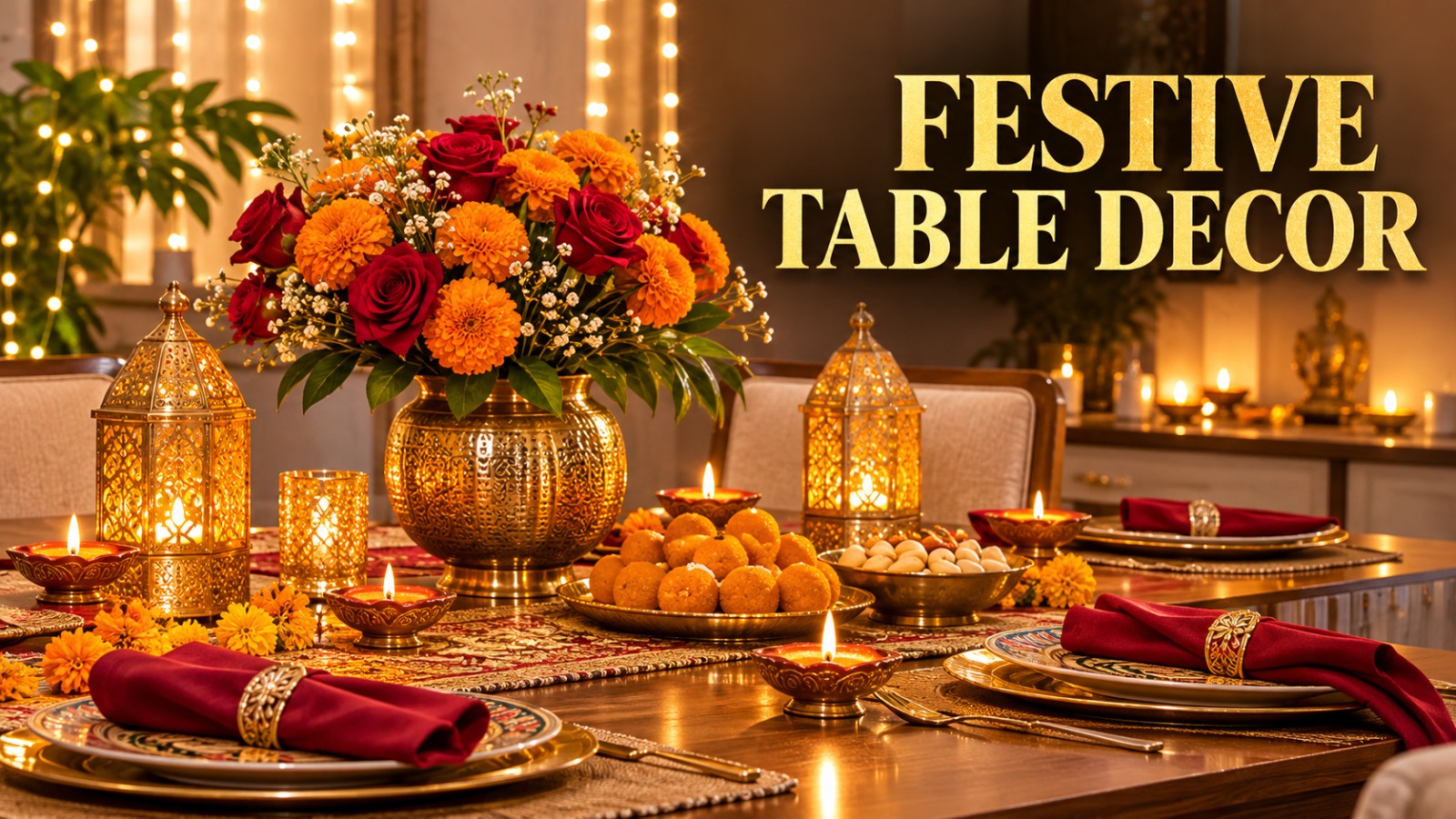
Every good Diwali table starts with a runner. A runner in deep red, gold, or cream, laid down the centre of the table, instantly makes an ordinary dining table look festive. It also protects the table from hot dishes and gives the centrepiece a defined space. Choose a runner that is about 30 cm wider than the table on each end, so it drapes slightly, and keep it flat and smooth so plates sit level.
Fabric matters. A silk or brocade runner with a gold border looks rich and traditional, while a linen runner in cream with a simple pattern suits a modern home. A runner with a floral print, such as peonies or roses, adds colour without needing many other decorations. If you do not have a runner, a long piece of fabric, a sari, or even a clean cotton dupatta in a festive colour works just as well.
Choosing Colours for the Table
Pick two colours and stick to them. Red and gold is the classic Diwali combination: a red runner, gold diyas, and cream plates. Maroon and cream is softer and suits a smaller table. Green and gold works well if your dining room has plants or a garden view. Avoid using every festive colour at once, because the table starts to look busy and the food, which is the real star, gets lost.
Plates and glasses should be simple. White or cream plates let the food and the decorations stand out, while gold-rimmed plates add a festive edge. Use the same glasses for everyone, and keep a jug of water and a small bowl of lemon on the table rather than individual bottles, which clutter the setting.
The Centrepiece: Diyas, Flowers and Light
The centrepiece runs down the middle of the table, on top of the runner. The classic Diwali centrepiece is a row of small diyas interspersed with marigold flowers, with a larger brass urli or a tall candle in the middle. Keep the centrepiece low, no higher than about 15 cm, so guests can see each other across the table. A tall centrepiece looks dramatic in photographs but makes conversation awkward.
A brass urli filled with water, floating flowers, and a small diya is a beautiful centrepiece that also stays cool and safe. Place it in the middle of the table and surround it with small diyas and marigold petals. For a long table, use three small urlis spaced along the runner instead of one large one. Battery candles are a good choice for a table with children, because they cannot be knocked over into the food.
Marigold and Rose Petal Arrangements
Scatter marigold petals loosely along the runner, between the diyas, for a natural, abundant look. A small bunch of roses in a low glass, placed at each end of the table, adds height without blocking the view. Avoid strong-smelling flowers at the dinner table, because they compete with the food: marigolds and roses are gentle enough, while jasmine can be too strong in a closed room.
Place Settings That Welcome Every Guest
A place setting is a small act of hospitality. At each place, set a plate, a napkin, and a glass, and add one small festive touch: a single marigold on the plate, a small sweet wrapped in gold paper, or a handwritten name card. Name cards are a lovely touch for a larger dinner, because they save the awkward moment of choosing seats, and children love finding their own name on the table.
Fold the napkins simply, in a triangle or a roll tied with a ribbon, and place them on the plate or to the left of it. A gold or red ribbon around the napkin matches the runner and costs almost nothing. For a family dinner, a small bowl of dry fruits or a piece of chocolate at each place doubles as a favour and a sweet start to the meal.
Serving and the Diwali Dinner Flow
On Diwali night, the table should be set before the puja, so dinner can begin as soon as the family sits down. Keep the serving dishes on a side table or a trolley, rather than crowding the dining table, so guests can serve themselves without reaching across the centrepiece. A sideboard with the sweets, the snacks, and the drinks keeps the main table clear for the meal itself.
Plan the flow of the evening: puja first, then a short break for fireworks or photographs, then dinner. The table, set and lit, waits for the family, and the diyas on the table are lit just before everyone sits down, so they burn brightest during the meal. After dinner, the table becomes the place for sweets and conversation, so keep a few diyas burning and the marigolds in place for the rest of the evening. For sweet ideas, see our Diwali sweets and recipes.
Table Decoration for Small Spaces and Buffets
Not every Diwali dinner happens at a dining table. Many families eat sitting on the floor, on a low table, or at a buffet. The same principles apply: a runner or a cloth defines the space, a low centrepiece of diyas and flowers marks the middle, and each place gets a small festive touch. For a floor seating, use a large cloth on the floor, place the food in the middle, and put a diya at each corner.
For a buffet, decorate the serving table rather than the eating table: a runner, a centrepiece of diyas and flowers, and labels for each dish. A small sign with the name of each sweet or snack helps guests, especially those trying a dish for the first time. Keep the buffet table against a wall, with the food at the back and the plates at the front, so the flow is smooth.
Helpful Finds for Your Diwali Table
A beautiful runner sets the whole table. - a table runner with peonies and roses in beige suits a classic Diwali setting, - a bohemian style table runner adds pattern and warmth, and - a modern minimalist runner works for a contemporary dining room.
- Table Runner Table Cover Peonies Roses Beige
- 1pc Bohemian Style Table Runner
- Elegant 36 Gray Lace Table Runner 90cm Exquisite Embroidered
- 1pc Modern Minimalist Table Runner Elegant Dining Decor
As an affiliate, EventBuzz may earn a commission on qualifying purchases at no extra cost to you.
Conclusion
A festive Diwali table is built from simple pieces: a runner in a rich colour, a low centrepiece of diyas and marigolds, and a small welcome at each place. Keep the centrepiece low so guests can talk, keep the flames away from the runner and napkins, and set the table before the puja so dinner can begin the moment the family sits down. On Sunday 8 November, after the lights and the prayers, the table is where Diwali becomes a shared meal, and a little care with the setting makes that meal feel like the celebration it is.
For more ideas, see our Diwali decoration ideas at home, Diwali party ideas 2026 hosting guide, and Diwali sweets and recipes.