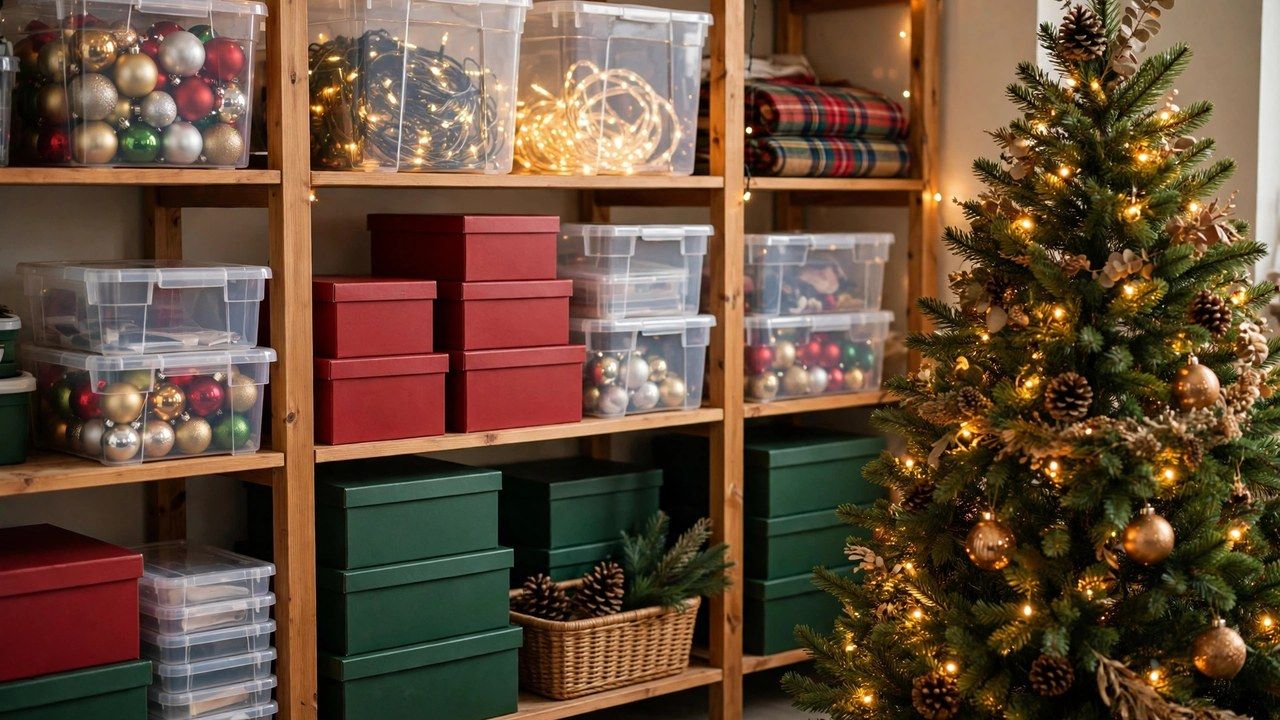
January has a sound: the crunch of a broken ornament at the bottom of a mystery box, the sigh over a light strand tangled beyond saving. Christmas storage and organization is the unglamorous chore that decides whether next December starts with delight or with a shopping trip to replace what careless packing destroyed. This guide gives you a complete pack-away system for 2026 — how to sort, protect, label and store every category of decor so it survives the year, fits the space you actually have, and comes back out in perfect order.
Work through it room by room while the decorations are still up and you can see what you own. Pair the system with our Christmas decoration ideas guide — the notes you take while packing become next year's decorating plan.
Start Before You Pack: Clean, Test and Let Go
Packing dirty, broken or unloved decor stores the problem for eleven months. Before a single box opens: dust and wipe items as they come down, test every light strand while a replacement is still easy to buy, and repair or discard damaged pieces honestly. Then make three piles — keep, donate, discard. Anything that stayed in the box through this entire season has told you its verdict; donate it in January while charity shops can still use it for next year, and note what you released so you do not 'replace' it by accident.
This fifteen-minute discipline is also the moment your storage volume shrinks. Most January messes are really December clutter problems postponed.
The Zone System: One Category, One Home
The core of christmas storage organization is zoning: every category of decor gets a designated container type and a designated shelf, every year, without exception.
| Category | Best container approach | Protection that matters |
|---|---|---|
| Ornaments | Divided boxes or small containers grouped by tree or room | Individual wrapping for fragile pieces; tissue or padding between layers |
| Light strands | Wound on cards, reels or hangers, one strand per wrap | Keeping strands separated — never stored loose in a shared tangle |
| Wreaths and garlands | Round or long containers, or covered hanging storage | Shape protection: nothing stacked on top of them |
| Linens and textiles | Clean storage in breathable bags or boxes | Washed before storing, fully dry, away from moisture |
| Gift wrap station | One tall container or under-bed box for rolls | Keeping rolls upright or flat so edges stay crisp |
| Outdoor decor | Sturdy bins that can handle garage or shed conditions | Dry before sealing; cords and stakes gathered with their items |
Clear containers earn their keep for one reason: you can identify contents at a glance next December, which prevents the buy-it-again mistake. Opaque boxes are fine only with the labeling discipline in the section below.
Ornaments: The Fragile-First Method
Pack ornaments in the order of fragility, not by where they hung. Sentimental and glass pieces get individual wrapping — tissue, reused gift paper, or their original boxes — and go in the center of a divided container where pressure is lowest. Sturdy shatterproof pieces fill the edges and the top layer. Keep one tree's ornaments together as a set so next year you can hand a whole container to whoever decorates that tree, informed by our tree decorating ideas. Egg cartons and muffin tins from the kitchen make excellent small-ornament trays in a pinch.
Lights Without the Tangle
Every light strand gets wound before it is stored — around a stiff card, a purpose-made reel, a clothes hanger, or even a flattened piece of cardboard with notches. Secure the plug end visibly so next year you can test the strand from the wrap in seconds. Store each strand separately, and slip any spare bulbs or fuses into a small bag taped inside the container lid. The five slow minutes per strand in January save the single most common December frustration there is.
Wreaths, Garlands and the Tree Itself
Wreaths lose their shape under weight, so they are stored hanging on a hook in a closet or storage room, or alone in a round container — never at the bottom of a decor pile. Garlands from our garland ideas guide should be gently coiled, not folded, and artificial greenery fluffs back better after a year if it was not crushed. For artificial trees, clean the branches, let them dry fully, and store in the tree's own bag or box, upright if space allows. Photograph the assembled tree before you dismantle it — that photo, saved with your inventory, is next year's assembly instructions.
Labeling and the One-Page Inventory
Label every container on two sides with three facts: contents category, the room or tree it belongs to, and anything fragile inside. Then make the master move: one inventory list — a phone note or a single page taped inside the first container's lid — listing every container and where it lives. Add two honest columns worth keeping: 'buy next year' (the strand that failed, the color you lacked) and 'let go' notes from this year's sort. When the after-Christmas sales open, our post-Christmas sales guide plus that list turns vague bargain-hunting into targeted restocking.
Where Storage Lives: Space and Climate Sense
Small homes are a space problem, not an organization problem: stackable uniform containers, the vertical space above closet shelves, under-bed boxes for wrap and linens, and the discipline of the zone system matter more than square footage. Our small apartment Christmas decor guide was written with exactly this storage reality in mind.
For any home, keep two climate rules: candles, wax items and anything heat-sensitive should avoid hot attics in summer, and anything fabric or paper should avoid damp basements unless sealed well. Electronics like timers and smart plugs prefer the same indoor conditions as your other devices.
A Realistic January Timeline
Split the pack-away across two short sessions rather than one exhausting day: session one for the tree and ornaments while energy is fresh, session two for lights, linens, outdoor pieces and the inventory list within the same week. Boxes labeled but left in the hallway for a month are the real January mess — the timeline ends when containers are on their shelves, not when they are merely closed.
The Honest Pros and Cons of a System
Pros: nothing breaks, nothing is bought twice, decorating next year takes half the time, and the house returns to normal in days. Cons: the first year of the system takes longer than stuffing boxes, good containers are a small upfront purchase, and the discipline has to be renewed while tired in January. The exchange is overwhelmingly worth it: you are buying eleven calm months and one joyful December with a single weekend of care.
The Awkward Extras: Wreaths' Companions and Leftover Supplies
Every system has leftovers that fit no zone: spare hooks and wire, half-used ribbon, the wreath-making supplies from a DIY wreath project, batteries, command strips and the craft materials behind homemade pieces from our DIY Christmas decorations guide. Give them one small 'support kit' container of their own rather than scattering them through the decor boxes — next December you will reach for this box more than any other, usually mid-project with hands full of garland. Restock it while packing, while you still remember what ran out: fresh batteries, new adhesive strips, spare ornament hooks. It is the least photogenic box you own and the one that quietly saves the most evenings.
Conclusion
Clean and sort first, zone every category into its own protected home, wind every strand, label like you mean it, and write the one-page inventory. Christmas storage organization done this way means next December opens with everything you love, intact and findable — and January keeps its dignity.